Wednesday, 29 December 2021

Discussion with Trevor Ristow and Mark Andrews, recent biographers of The Sisters of Mercy


Ten years ago, after a few years of interested but furtive lurking, I finally joined Heartland Forum, the venerable online chatroom for those obsessed with The Sisters of Mercy, and began to post half-remembered details of gigs by the band which I had attended in the early 1980’s. From comments made by fellow fans who hadn’t had the good fortune to see the earlier iterations of the band, there seemed to be quite an appetite for examining the band’s history in greater detail than had been provided in Andrew Pinnell’s excellent Heartland journals, so I tentatively began to write this blog, I Was A Teenage Sisters of Mercy Fan. Early posts garnered only forty or so views each (nowadays a new post will clock up a couple of thousand views within days), but I was hugely encouraged by being contacted by fellow fans, historians and collectors from around the world who were only too happy to share their own reminiscences, artefacts and audio rarities via the blog, a process which accelerated significantly once Phil Verne began the wonderful The Sisters of Mercy 1980-1985 Facebook fan group, and some of the cloudier episodes of the band’s past began to become clearer.

Since that time, historical interest in the Leeds scene in general and The Sisters in particular has snowballed, with documentaries, fanzine compilations, and some fantastically researched and well-written articles by Mark Andrews for The Quietus giving rise for calls for a full biography of the band.

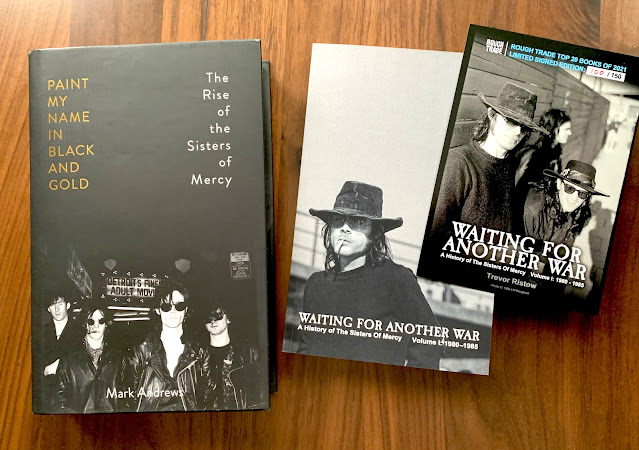
This stirred Trevor Ristow, the compiler of the legendary Romance and Assassination cuttings compilations, into revamping his long-abandoned biography of the band’s early years, culminating in the publication of the superb Waiting For Another War last year, neatly halfway between the original crowdfunding launch and the recent publication of Mark Andrews’ own meticulously-researched book about the band’s first five years, Paint My Name In Black And Gold.

This month sees the tenth anniversary of the launch of this blog, so when Trevor suggested a three-way chat with himself and Mark to discuss their books, the band and its legacy, it seemed too good an opportunity to miss! My grateful thanks are due to Mark and Trevor for their fascinating replies during our Transatlantic conversation.


___________________________________________________________________________

Nikolas Vitus Lagartija (NVL): Congratulations, guys, on your books which have been, rightly, fantastically well-received by Sisters fans. Our forty-year wait for a full biography of the band has ended in spectacular style, with the books coming out within a year of each other. When you first learned about each other’s project, did you feel any fear that your own book might be devalued by the near simultaneous publication of the other? 

Trevor Ristow (TR): On the contrary, I always knew that these two books would complement rather than compete with one another. I have tons of books on the same or overlapping subjects. I’ve read probably seven or eight books on the Manson Family. I own – and have read – three books on post-reunification architecture in Berlin alone, to choose a more obscure subject. And on and on. Every history book has its own perspective, its own facts, its own takeaways. So I’m used to reading widely on things that interest me, and I know that multiple books by different authors offer a fuller picture than a single book by itself.

Mark Andrews (MA): There are 820 books about Bob Dylan – that’s just the ones in English – so by that measure there aren’t nearly enough about The Sisters. When Trev told me about his, I was sure the two books would be very different, even though we were writing about an almost identical time period. I was intending to have original interviews do most of the heavy lifting, and to include more material on Leeds. Both of those approaches were set at the very beginning in that first article I wrote for The Quietus in 2016.

TR: Also, I think if you can honestly say that one book on this band is sufficient, then you don’t really know what it means to be a Sisters fan. We need every detail.

NVL: Amen to that! You have both made very positive comments about each other’s book. What did you like most about the “other” book? 

MA: That it's a book created with absolute care and respect for the source material. I specifically enjoyed the material from obscure fanzines and reviews, and the American interviewees - basically, the things I didn't know about even though I was deep into writing my own book. In fact, you can probably tell which bits of Waiting For Another War I really liked because I put them in Paint My Name In Black and Gold! The Sisters crashing Joe Jackson's party in San Francisco in 1983 was an obvious keeper...

TR: Thanks, Mark. I love Paint My Name’s on-the-ground, in-the-van perspective. It’s so rich with anecdotes from people who were there that you can almost choke on the fog. And, as I’ve said before, I love all the Gary Marx. I think his thoughtful perspective has long been absent from the story of the band’s first five years and your book is a perfect corrective. I also really enjoyed the focus on the Leeds music scene – the overlapping bands, the social connections, the clubs and bars. You painted a detailed portrait of the place that nurtured The Sisters which really adds a layer for diehard Sisters fans, many of whom have made the ‘Haj’ to Leeds, and a lot of those specific addresses, in years past.

NVL: You both became 'older dads' while trying to write and publish your books. Are you crazy or what!? Or can Sisters fans thank some synchronous trans-Atlantic mid-life crisis for these two books?

TR: Ha! It sure has been a weird time. Since I sent this book to the printers I’ve moved three times, packed and unpacked my belongings, and welcomed my second son. Yes, it’s been difficult. But occasionally you get an email or read a comment online from someone who says how the book made lockdown bearable for a week, or even just took them out of themselves for a few hours, and you realise that everyone has had a tough couple of years. Then the whole project feels worth it.

MA: I just checked the timings: crowd-funding for Paint My Name began two weeks before my youngest daughter was born. Therefore, pregnancy, birth and her early years run virtually concurrent with writing and publishing my book. Both have brought me great delight and have considerably reduced the risk of some mid-life or pandemic-induced meltdown.

TR: I’m curious, does your family also love The Sisters?

MA: To be quite clear, my wife could not give two shits about The Sisters of Mercy! Therefore she is quite rightly acknowledged at the end of Paint My Name for her support during the researching and writing of the book. Our tastes for chain-smoking singers intersect at Serge Gainsbourg and Jacques Brel rather than Andrew Eldritch. Out of all my family, the one with any interest in the band is my 82-year old mother. She has actually heard them live. She caught the end of Sister Ray one time while collecting me from a gig as a teenager. The band were so loud that the car she was in outside the venue was vibrating, like the bit in Jurassic Park when the T Rex appears, but over and over again, in 4/4 time.

TR: I am fortunate that my wife loves the band, and my kids are learning to love them too. My son once asked for Flood in the car. I put it on and he said, “no, Flood Two.” No joke. He was three. Nik, what about you?

NVL: Mrs L is probably the most “un-goth” person you could meet, and my kids never wanted to listen to the “guy who can’t sing” so it was headphones for me all the way! Instead, they would ask to listen to “Angela” – the growling then-singer of Arch Enemy! I have failed as a father …

MA: Trev, we're both - in different ways - connected to film. Tell me about the film version of your book.

TR: Man, I’d love to do a feature film on The Sisters. I’ve thought about it. All I need is someone to underwrite it. Maybe a William Gibson/Simon Pegg co-production.

MA: Stunt casting: get Kristin Stewart to play Eldritch. She was a terrific Joan Jett, so she’s halfway there.

NVL: Back to the books - you both interviewed many people from the band’s entourage at the time. Who was your best interviewee? 

TR: Everyone I spoke with was extremely helpful. Some of my “interviews” were conducted very casually. Like, shouting over music in a venue with someone I’d just met. Some were done more formally. Among the most helpful were the New York contingent – friends of the band who really opened the door for me on the band’s time in the US. Saadia Tiare, Jenny Foster, Lisa Levine, David Arnoff, and a handful of other intimates from those fun, early trips stateside. It was a real pleasure to speak with everyone for this book.

MA: The obvious answer is Gary Marx but the most memorable was Dave Beer. His interview took place at his house in Headingley. I ended up with nearly four hours on tape – not including the numerous breaks: one was to get firelighters and more wine from the nearest petrol station, another was to eat leftover take-way and another was to locate a record player so we could hear the tracks that he’d recorded as The God Squad in the 90s based on Sisters samples; whether the record was supposed to play at 45rpm or 33rpm took a while to work out by that point in the evening. While I was talking to him I was under the impression that he was highly intelligent, screamingly funny and was providing me with countless quotable anecdotes and great insights into The Sisters and the West Yorkshire music scene. However, regrettably, I had a noticeable hangover the next day and couldn’t face transcribing the tape for months afterwards for fear of whatever drunken crap I might find on it. When I did listen back, I was shocked to discover that not only was I entirely lucid throughout, but he was an even better interviewee than I thought he was at the time.

NVL: Did you find most people you contacted were proud of their connection to TSOM and were willing to talk freely? 

MA: People were very willing to talk. The only people who turned me down for an interview, both through intermediaries, were Tony James and Si Denbigh. For several interviewees, particularly some of The God Squad, pride would be too weak a word to describe their feelings about the band, the music and that part of their lives they gave over to The Sisters of Mercy. Of course, many interviewees had complicated and not always entirely pleasant relationships with the band, particularly with Andrew Eldritch …

TR: I also had a few people turn me down despite multiple overtures. But, for the people I did speak with, their time spent in The Sisters’ orbit was really meaningful and memorable to them. That’s one of the defining characteristics of this band and it partly explains their rabid fanbase.

NVL: Was there anyone whom you’d have liked to have spoken to but weren’t able to? 

MA: Other than Denbigh and James, Ben Gunn. I'm not sure I even successfully got a request through for him to say no to. He seems to have been well and truly done with The Sisters for close to 40 years now, so I'm not sure it would have been a good interview even had I winkled him out. To make up for that omission, I think it's him I follow him on Twitter - and if it's not him, I still like reading about this other guy's commitment to urban cycling. And I'm fairly sure I saw Gunn on YouTube in a recording of a Zoom meeting of his local council. I didn't interview Eldritch but I was always convinced a book without a new Eldritch interview would work very well regardless, so I was never that concerned whether he talked on the record or not: a large number of people "talking about (him) like they know" would create interesting ways of filling in that Eldritch-shaped hole. Readers of Paint My Name, I think, can see the Eldritch they want to among the smoke and coloured lights of those various testimonies ... I've spoken to Eldritch more since the manuscript was submitted to Unbound than I did before: he does indeed seem to be a charming, intelligent, funny and highly likeable fellow. Therefore he did me the great favour of not talking to me before I wrote the book: I did not have that wholly favourable impression of him hanging over me when I had to write about the Eldritch of 1984-85.

TR: Ben Gunn would have been a great interview. For me, I’d have liked to connect with Bryan Christian, with whom I share many mutual friends but who rather persistently declined to speak with me. And, of course, Andrew Eldritch. Mark, I think I remember you telling me that you visited 7 Village Place – the inside of it – during your research. What was that like?

MA: I was checking out some Leeds landmarks and drove out to Burley. Rather than just look at the exterior of this mythical location, I thought I’d ring the bell and see if anyone was in. The door was opened by a young woman in her dressing gown. This was about midday. I explained why I was there and, realizing how odd this sounded, took two steps back and offered to show her some ID. I then noticed her boyfriend in bed behind her – in what was once the infamous blacked-out sitting room. So I then explained to him the significance of the room he was lying in. And they still let me in, bless them!

It turned out 7 Village Place was being rented by three young women from Leeds University and was quite clearly better decorated and cleaner than in its heyday. I had a wander around and stuck my head into what had once been ‘Mark’s Room’, ‘Claire’s Room’ and ‘Andy’s Room’. I asked about the cellar where so much musical history was made. I was informed that no-one went down there, as it was the final resting place of the landlord’s mouldy fridge and freezer. As I was leaving, the couple asked me to tell them the name again of the famous Leeds band from the 80s that used to live there. “The Sisters of Mercy,” I proudly announced. “I’ll ask my Gran, she might have heard of them,” said the young woman in the dressing gown.

NVL: Both books included some amazing, never previously seen photos of the band from the 1980’s. How difficult were these to track down? 

MA: Some were really easy; some took aeons to arrange. I remember first phoning Tony Mottram from a hotel room in Manchester in February 2019; we closed the deal for five of his excellent photos over two years later! At the opposite end of the spectrum was Jon Langford. I commissioned an original piece of Sisters-themed art from him and he suggested using one of his own photos. This is the one he let Unbound have for the book without charge. I had excellent tip-offs from Phil Verne and Bruno Bossier who showed me images in their collections. Thank you, Phil and Bruno!

NVL: Seconded! And I’d add the collector LG to that list by the way, he’s also been incredibly helpful with the blog. Tell us how you sourced the photos in WFAW, Trevor.

TR: I wanted to find some completely unseen photos of the band. Not just unpublished – by which I mean, maybe they’ve never been printed in a magazine but everyone’s seen them online anyway – but really, genuinely unseen. Also offstage photos. Live photos of the band are pretty common and can feel slightly samey to someone who’s spent a lifetime as a Sisters fan. So yes, this was a big challenge. And I can confirm Mark’s comment that it takes time and, above all, persistence, to unearth these kinds of photos. In some cases it took me years to chase them down. I was thrilled not only to find, but license, never-before-seen photos by outstanding photographers like Ulf Berglund, Daryl-Ann Saunders, Fred Berger, Larry Rodriguez and David Arnoff.

And then there are the photos that aren’t necessarily of the band but add context to the story. I am also proud of these, like Saadia Tiare’s photo of Jenny Foster with her friends in Washington Square Park. It’s such a great artefact of the times; I look at that photo and think, this picture says more than my two or three pages of description of the New York scene that The Sisters stepped into in 1983, 1984. These young, hopeful, kind of gothy girls sitting in the very heart of New York’s Greenwich Village. Jenny Foster with her thousands of bangles that would soon be immortalised in A Rock And A Hard Place. That’s one of my favourite photos in the book.

NVL: What was the most difficult aspect of getting your book to publication? 

TR: Apart from the photos, it was my own busy schedule. I had planned a huge volume, basically 1980 to the present. I was going to write it all, then reach out to the band, do interviews with everyone I could from every period, integrate all that material, track down photos, etc. Let’s be honest: this book would have been 2000 pages and I may never have finished it at all. So here I have to say a big thanks (again) to Mark because my book likely wouldn’t have seen the light of day without his encouragement to push past my natural inclination to sit on an incomplete manuscript, maybe forever.

MA: The crowd-funding phase. It seemed at one point in 2019 that it wouldn’t fund and that there would be no book.

NVL: The response to both books indicates the enduring appeal of TSOM compared to many of their contemporaries. Why is it that the band seems to exert such a hold over its followers, in your opinion? 

MA: They were much, much better than their contemporaries is the short answer. Beyond that you have to wade into the complex emotions and psychology of why some people have long-lasting and deep relationships with songs and bands: the ancient Greeks needed an eighth word for that kind of love. I mean, what is the correct word for what I feel when I hear the Funhouse album by the Stooges and am close to tears by the time TV Eye comes on? I could tell you why I have maintained a relationship with The Sisters all this time: I wrote a book about it - and that only really goes up to 1986-ish. There's another 35 years after that which needs explaining. That I'm a committed and unapologetic Eldritchophile explains a lot. Has it been plain sailing over those decades for those of our ilk? Good God no! But "with Swann, you forgive a lot, you know."

TR: I’ll co-sign Mark’s answer that The Sisters enduring appeal rests on the quality of the work. The music connects to you, the heart or the knees, usually both. Not every band can do that.

NVL: You both chose a lyrical fragment as title to your book that only firm fans of the band would recognise, rather than a more obvious “Tales From The Temple of Love” type title. Did you consider any other titles, and why did you eventually plump for your final choice? 

(pic credit: Trevor Ristow)


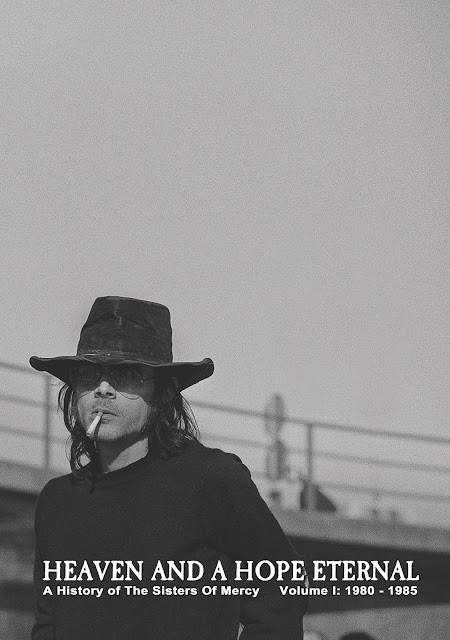
TR: My book has had three titles. First it was Mission And Revenge, but that title is really only suitable for the version of the book that goes to the present day. When I decided to print 1980-1985 as Volume I, I renamed it Heaven And A Hope Eternal, a Body And Soul lyric. But I scrapped that at the last moment, after designing the cover and everything. Waiting For Another War recommended itself to me for a few reasons. Fix and Valentine have always been two of my favourite songs. My old Sisters ‘zines from the 80s were called Romance And Assassination, a highly evocative lyric from Fix, so I thought, why not try to find a title from Valentine for this one? “Waiting for another war” is a great line, very Sisters. It’s a little violent: a subtle, anticipatory violence that’s more threatening because it’s controlled, restrained, like the band. It’s a bit pessimistic, a bit hostile, a bit droll.

MA: At one point it was Shot With A Diamond Bullet – that ended up in one of the opening quotes. Then it was Heartland when it was going to be even more a Leeds-y book than it is now but I was really looking for something like Meet Me In The Bathroom, the title of Lizzy Goodman’s book on the New York music scene. That’s how I ended up at Paint My Name in Black and Gold, which I couldn’t top. I still really like it.

NVL: Both books have also received great praise for the writing style. How important was it to you to get the prose style right? 

MA: My style is based on the assumption that readers are more interested in The Sisters of Mercy (or any other band I choose to write about) than they are in me and any literary flourishes I might choose to foist upon them. It's a safe assumption. I like the process of editing my own writing. I don't have a problem cutting my own crap or 'killing my darlings': if it's got to go, it's got to go, whether that's thousands of words or a comma. I don't find re-reading and re-writing over and over again remotely tedious. And I was very happy to get into it all over again with the editors - and the lawyer! - Unbound provided.

TR: The writing in both books is pretty straightforward, so a reader can kind of get lost in the narrative without thinking about the style.

MA: Trev - we both have some background in academic History as students. Do you think we wrote -- accidentally or on purpose -- history books rather than music bios?

TR: Maybe, yeah. A lot of music bios are hagiographies masquerading as history. I didn’t want to write that kind of book, and clearly you didn’t either. Two of my favourite historians – at least when I was younger – were AJP Taylor and Michael Howard. These were towering figures in British academia for good reason. Both wrote wonderfully simple prose, not ornamented or prolix, but the substance of their work was always challenging. After reading pretty much everything these guys wrote I must have copied their approach to some extent, even subconsciously. I think my love of the band comes through in the book even if I didn’t use a lot of superlatives and exclamation points.

MA: I certainly didn’t want to pretend I’m a music journalist, that’s for sure. I most definitely am not; I have no interest in reviewing bands or live shows for a start. But I do like research and I was quite happy to go down various rabbit holes when I was working on Paint My Name, just for the hell of it. Case in point: I spent a Saturday morning in the Brotherton Library of Leeds University reading their special collection of documents on the foundation and development of the Chinese Studies course. After dragging myself through a BA (Hons) Modern History degree between 1986 and 1989, I do actually feel like I have redeemed my history credentials with Paint My Name In Black and Gold!

NVL: The look and feel of both books have also garnered praise. How much say did you have in the appearance of the final artefact?

TR: I did everything entirely myself.

MA: Other than writing it and going through the sundry editorial processes – and sourcing photos – I did none of it. I had no reason to insert myself into the working practices of professional publishers. The exception was early on when I suggested that the cover should be a Sisters-as-the-Stooges pastiche of the Funhouse gatefold cover. That was never seriously considered, especially once the Head of Publishing at Unbound got in contact with Ruth Polsky’s brother and obtained the rights for the ‘Detroit’s Finest’ photo. I haven’t actually seen or touched my own book yet. My copies are in the UK and I live in Belgium. And no way am I risking the post-Brexit charges BPost might stick on a box of books coming into the country. And I’m not complaining about the Belgian postal service, I’m complaining about the lunacy of Brexit.

TR: I think Eldritch paid homage to that Funhouse collage style on the back cover of Vision Thing.

MA: I reckon Tim Bricheno got Photoshopped in (or whatever the equivalent was in 1990) at the last minute.

NVL: Neither of you saw the band in its very early days, although you did both see them for the first time just before the 1985 split. If you could jump in a time machine and go back to witness one of the concerts from the 80’s, which would you choose? 

MA: I saw The Sisters at the Lanchester Polytechnic in Coventry on 14 March 1985. It was my first ever gig. I remember nothing about it. So for old time's sake I'd like to see that one again. I remember the minutes before the band came on: the smoke being pumped out  - especially the fruity smell - and the Head and Star logos lit up at the back of the stage but when the Doktor started up, all hell broke loose: a significant portion of the audience seemed to be trying to kill each other and take me with them. I remember forcing my way to the back of the sports hall the gig was in to get away from them ... and then: nothing. This I now realise was God Squad-induced shock. I had no idea what ferocious chicken dancing was at that time (For context: my second gig was Tina Turner supported by Bryan Adams at the NEC; I was there for Bryan Adams.) I guarantee that me and my mate Clark were the squarest people at that Sisters gig at the Lanch: I was there in my grey school trousers and he was almost certainly there in some stone-washed blue jeans. He's still a Sisters fan too.

TR: This is definitely the hardest question so far. I remember almost everything about the Kabuki gig in 1985, so I’d leave that one off my list. Naturally I’d prefer to choose one gig from every period or line-up. For example, I’d be thrilled to transport to the Paradiso in Amsterdam on 28 August 1983. But you asked about one, so I’d narrow it down to the line-up I really wish I’d seen: Eldritch, Hussey, Marx and Adams. I could be predictable and say Tiffany’s Newcastle 1985 but actually I miss Knockin’ On Heaven’s Door in that gig. So if pressed I’d probably visit Leeds University on 16 March 1985. It’s maybe not the best quality bootleg recording but I think it’s got to be one of the best performances and setlists. If I had a bit more gas left in the time machine I’d hit Münster Odeon on 17 November 1984. These are the gigs I have often dreamed of being at. There are also some later Sisters gigs I was at that I barely remember, so I wouldn’t mind going back and reliving those without having to crawl out of them.

MA: If we looked at your tastes and interests pre-Sisters, Trev, what clues would we find this would be a band that would really get their hooks into you?

TR: Great question. I grew up in a kind of hippie, dreamcatcher, Grateful Dead San Francisco. I found that whole scene irritating. I discovered The Sisters at a time of enormous change in my life, in my very early teens, a period of intense exploration. I guess most people would simply call this adolescence. My big touchstone albums at the time were Adam Ant’s Friend Or Foe and Billy Idol’s Rebel Yell. OK, not exactly transgressive music, but I was a kid. From there I went backwards into Adam And The Ants and Generation X, and I wanted to keep exploring. I was ready for something deeper than pop-punk.

Punk – real punk – was a middle finger raised to the establishment and mainstream culture, which was stultifying for kids in the late ‘70s. The appeal of punk is no mystery. But I missed it, or it missed me. I really wasn’t interested in the simple fuck-you of punk, in the same way I wasn’t interested in the flowerchild jam-band bullshit of The Grateful Dead. The Sisters spoke to me in a completely different way. They had some of the energy of punk, but an intellectual side entirely absent from The Sex Pistols. Everything about them just seemed cooler, more intelligent, more original and a shade darker than other bands.

My parents were definitely not hippies. My dad used to take me to gun shows around San Francisco, which I loved. Hard to believe San Francisco ever permitted gun shows, but in the ‘80s it did. So I inherited from my dad an interest in weapons, and military history. Anyway, at these gun shows I’d see these military medals I could afford to collect, old World War I medals, $5 each or something. I thought, what a cool idea. I still collect old medals and militaria. My dad also always said that if Russia nuked us, he’d climb up on our roof and just admire the mushroom cloud. He still has a huge coffee-table book of nuclear explosion photos. Our home was filled with books. I was always a big reader. Not that my parents ever liked The Sisters, or could name a single song, but when I discovered the band, they fell on very fertile ground. Eldritch talked in interviews, or wrote in lyrics, about a lot of the things I was already interested in: sex and drugs – perennial preoccupations of city boys – weapons, propaganda, even shopping for militaria in Hamburg with Lemmy. Half the girls I grew up with were Alice. The band reminded me a little of San Francisco hometown legends Chrome, who I loved. And Eldritch was very witty. I had a lot of identification with this band from the beginning. I think about that Craig Adams quote in Paint My Name, that Eldritch “talked all kinds of shit all the time,” that all his high-concept theorising was “twaddle.” But all that stuff he said in interviews was fascinating to me. I was a Cold War kid, 13 or 14 years old, and here was a guy who made great music and had some theory about how to enjoy life under the threat of nuclear annihilation, among many other things. Was he trying to find something shocking for a pull-quote? Probably. But it was better than reading a Robert Smith interview. And then there was a community around the band that I opted into. Fanzines, collectors, traders, tapers. I still have four or five big files with old correspondence and trade lists from them. It was a whole world that was simultaneously comfortable and stimulating to me. It made sense.

MA: Same question to you too, Nik!

NVL: Me? I suppose the biggest clue is that I tended to be a fairly obsessive fan of all the bands I’d really got into up to the point – The Jam and The Stranglers in ‘78, The Banshees in ‘79, Killing Joke in ‘80, then Bauhaus and UK Decay in 1981, before The Sisters – but catching The Sisters before they’d even made the indie charts definitely made them more special, “our” band. Musically, I’d love to say I’d been a huge fan of The Doors, the Velvets and The Stooges, but I had Jym at The Phono in Leeds to thank for that essential pre-punk part of my musical education, which had been strictly post Year Zero (of punk) up until then. How about you, Mark?

MA: Pre-1984, you would have found nothing like The Sisters amongst my records. Even post-1984, they are still a bit of an outlier. The Sisters ensnared me at 16, at a major transitional moment in my music taste – the next big one was when I was 30 and got heavily into funk and disco thanks to Barry White – it’s a beautiful story, trust me! In 1984 I was coming out of a Heavy Metal phase: Iron Maiden’s fourth album had finished me off, but I was still looking for something with fuzzy guitars and heavy drums and theatrical – and what I would now describe as camp – so I was ripe for the plucking when someone put Floorshow on the record player in the Sixth Form Common Room at my school. Before that, I think there are some pointers, albeit quite tangential ones, that I would fall prey to The Sisters: I had the Morricone Dollars soundtracks; Springsteen’s Darkness on the Edge of Town – and his sideburns; Joan Jett’s Bad Reputation – two Glitter covers on it and she was leather-jacketed Ramones fan; and it was obvious Motorhead were the best thing on Axe Attack Volume 2 by miles. I was also obsessed with the Giorgio Moroder soundtrack to Cat People.

Talking of songs: which songs really grew in status for you during the process of producing your book - and Nik, researching your blog posts? And which remain lesser works. I could commit multiple acts of heresy when I answer this!

NVL: Whisper it quietly, but like a lot of the ‘82/’83 Sisters fans, I was never a fan of the Hussey era at the time, with a particular loathing for Body And Soul and No Time To Cry. However, I’ve really learned to appreciate the subtlety of the latter in recent years, but the former is still almost unlistenable for me in its studio version. Of the earlier songs, I have rehabilitated Watch, which again I never had much time for, and studying it in detail for a blog post, I really got into Driver.

TR: I’m not sure how much my personal feelings about the songs were shaped by writing the book; for the most part I’d been thinking about and living with my ideas about the lyrics for years by the time I wrote about them. But I do understand how the songs can rise and fall in a listener’s estimation over the years. Because of the complexity of the language, the songs are living things.

MA: Those that already had a seat at the top table and which just blew my mind some more were Fix and Nine While Nine. And Heartland really rocketed up my charts. I think for decades I’d undervalued it because in my mind it was sandwiched between Temple of Love and Gimme Shelter on the 12”. One track which I had never been overly keen on which asserted itself when I was writing the book – lyrically and musically – was Black Planet. I’m convinced it’s about numerous kinds of obliteration: Armageddon, the Decline of Fall of the American Empire and personal altered states best achieved in the hours of darkness!

NVL: Time for the “multiple acts of heresy”, Mark!

MA: Is that firewood and a stake I see before me? My nerve has failed me, but I will say that I’ve never much liked A Rock and a Hard Place and Burn has always seemed to me the least interesting track on The Reptile House by some distance and writing the book did not change that. These surely can’t be anyone’s favourite Sisters tracks, can they? Answer: bloody right they could. The Sisters are a broad church.

I have another question for you both. Beyond the period of your book – and blog – what are your feelings about the band?

TR: I love them.

NVL: Like Trev, I’ve enjoyed all the phases of the band, but I particularly enjoyed 90-92 when The Sisters became a real band again. What about you, Mark?

MA: There was a period about ten years ago where I deliberately abandoned the band – I caught them on a bad night two gigs running. It was your blog Nik that was my route back, to where I find myself now – not just as the author of Paint My Name - but as a full-on Sisters fan again. I’m very grateful for that. I absolutely loved the Floodland singles and seeing Eldritch and Morrison on TV. Plenty of Sisters concerts over the last 30 years have been sensational – and I include the three Belgian ones in 2019 in that.

NVL: A lot of the band’s initial growth from just another post-punk band to cult icons seems to have been due in part to the cloak of mystery that seemed to surround the band, partially as a result of their stage presence. Did you worry that telling the history of the band “warts’n’all” might reduce their appeal? 

TR: Not really.

MA: Their appeal is unassailable and Eldritch, by and large, remains a mystery – to me at least. And of course, on the Richter Scale of rock band atrocities, there’s nothing that awful in Paint My Name, nor on the cutting room floor that the lawyers hoicked out. No-one arrives at Victoria Station and gives a Nazi salute, or kills the drummer of a Swedish hair metal band in a car crash; or shacks up with a underage girls; or chokes on their own vomit in a Mini.

Now the dust has settled, what would you change about your book or blog – this could be cuts, additions or simply corrections? Or by making all copyright and libel laws disappear?

TR: In some future edition I will correct a couple errors. But there are some events that are simply presented differently in the three books we now have about The Sisters. You know, the major protagonists in this saga will have different memories, and I don’t consider any one account necessarily canonical. So, to me, having three or four slightly different takes on the same event is another strength of having three or four accounts in print. I’m sure the truth of any one specific story lies somewhere between these versions.

The only material I sometimes wonder about having excised is lyric analysis. The book used to have more of that – a theory about a cryptic crossword clue in Possession, another about “Baby buy the number three” from Anaconda, a bit about Crash And Burn in the introduction, and so on. But I decided that most of these ideas were better suited to comments on a forum. In the end I left in only what I thought was defensible.

In terms of personal details, I don’t regret anything I cut, or never wrote. One insider related a shocking story to me about Doktor Avalanche rolling into Hamburg Hauptbahnhof in ‘83 and giving a Nazi salute. But I’m not one to trash an otherwise spotless reputation for sport.

MA: Damn right, I had to pull loads because Unbound were fully aware of the Doktor (and his solicitor's) savage reputation. Beyond that, I would note that Eldritch insists he’s never met Nick Cave or Brian James, contrary to what is written in Paint My Name. And beyond that kind of thing, I’m aware of three outright errors.

NVL: I suppose that the good thing about a blog is that you can go back and make edits, although there are still plenty of errors to correct. When I retire from my “normal” job, I plan to revamp the blog a bit and update some of the earlier posts.

MA: The Sisters are still alive and well, but who do you think are the inheritors of their crown? Who’s carrying that particular baton?

TR: This is a tricky, personal question because I’ve found that Sisters fans react to all different aspects of the band. One guy’s favourite track might be Vision Thing and his other favourite band is Taake, and another might be a huge Sisters/Celine Dion fan, and there’s no real contradiction there. They cover a lot of territory. The only two remotely recent artists who have moved me in a similar way are Zola Jesus and the Pink Mountaintops’ album Outside Love.

NVL: I agree, this is a really tough question, as The Sisters were so unique. I’m not ashamed to admit that I like some of the more obviously TSOM influenced artists, such as Miazma or The Cascades, and I’m still very much into the contemporary goth scene, and run a second blog where I review and interview current bands. There are so many great bands around, from Then Comes Silence to Whispering Sons, She Past Away to Ground Nero, Kentucky Vampires to Black Angel.

MA: For me, in terms of peak Eldritchian camp, artifice and persona, it has to Lana Del Rey!

NVL: Since publication of your books, have you had any feedback (direct or indirect?) from band members? 

MA: Marx and Adams read full drafts before Paint My Name went to press. Hussey read the bits with him in. I didn't hear any complaints. Marx and Adams have had hardback copies sent to them. The West Yorkshire-bound one has arrived; Marx read it during a power cut and I'm more than delighted with his review. Eldritch declined to be sent a copy.

TR: I’ve had feedback from here and there, direct by email as well as indirect, and it has been very positive.

NVL: What is your next writing project? Do you intend to write any further books about TSOM? 

TR: I have enough fuel in the tank for one more. I also have another non-Sisters project planned for way down the road. I’ve found that I enjoy the process of writing.

MA: In my very early notes – which I just had a look at - I seem to have jotted down the titles of a five-book series on The Sisters! This was when I was originally going to stop at 1984 and call the first one Heartland, so these other titles are: White Line Fever 1984-90; Jet Black Leather Machine 1990-1996; Empire Down (or Ozymandias) 1996-2005; and Distance Over Time 2005-. I will not be writing any of these.

However, I will write White Rose Babylon, a history of punk and postpunk Leeds – the city and its music. For years I’ve toyed with writing something about the music scene in the East Village in NYC in the 80s and 90s. I’m a huge fan of Pussy Galore, Boss Hog and the Blues Explosion, pretty much anything Jon Spencer does. I’m also considering pitching a book to the publishers of the 33 1/3 series called The Sisters of Mercy’s Long-Awaited Fourth Studio Album.


Paint My Name in Black and Gold was published by Unbound (from whom the ebook version may be purchased) and the hardback is still available from some online booksellers.

Waiting For Another War was published by GKW and a special limited edition paperback version is currently available from Rough Trade.

Wednesday, 17 November 2021

Book Review: Paint My Name In Black And Gold – The Rise of The Sisters of Mercy by Mark Andrews


After a forty year drought, the past eighteen months had already seen the publication of two excellent books on the mid-80’s heyday of The Sisters of Mercy, Wayne Hussey’s entertaining autobiography Salad Daze and Trevor Ristow’s potted history Waiting For Another War, but this week’s long-awaited publication of Mark Andrews’ definitive biography of the band’s early years, Paint My Name In Black And Gold finally explains the fascinating genesis and enduring legacy of a Northern British provincial band whose influence is still felt four decades later.

Funded through a subscriber publishing site, Unbound, Andrews’ magnum opus took a while to reach its financial target when first mooted, and the global pandemic delayed matters further, but the appetites whetted by Andrews’ superlative articles about the band’s early years for The Quietus will be fully sated by the finished product, published in a pleasingly weighty hardback edition fully worthy of the subject matter within.


Whereas Ristow’s book lifted the lid primarily on the pivotal Autumn 1983 North American tour that saw the band spectacularly broaden its reach and horizons yet lose second guitarist Ben Gunn in the process, Andrews’ book focuses on an equally little-known period of the band’s history, its formation in the politically-charged post-punk scene in Leeds in the late 1970’s, for which only Eldritch’s own “official version” on the band’s archaic website was known.  Andrews’ skilful way with words and carefully chosen prose lends the same gravitas to the biography as Eldritch’s own utterances in contemporary interviews, making him the ideal biographer for a band for whom their fans’ never-ending and reverent fascination will only be heightened by this skilful demystification of the groups’ early days, which had been shrouded in a mystery as thick as the dry ice which enveloped the band’s mesmeric live performances.

Whereas the US-domiciled Ristow painstakingly reconstructed the band’s history by pulling together facts gleaned from a lifetime of study of previously-published interviews in oft-obscure fanzines and magazines, Andrews ventured forth from his Belgian base to interview the key players on the Leeds scene, from promoters and producers to members of contemporary bands, including, crucially, members of The Sisters of Mercy themselves. Andrew Eldritch did not participate directly in the book, but Andrews was able to use material gathered when he spoke with the enigmatic singer for one of the Quietus interviews, again adding to the authenticity of the text.

Interviews with fellow founder member Gary Marx from his brief solo career in the early 2000’s had revealed him to be a wry and pithy raconteur, with an excellent memory for detail, a self-deprecating wit and a ready ability to prick the pomposity which often surrounds the band, all whilst cogently analysing the reasons for the band’s successes and failures. It therefore comes as no surprise that quotes from Marx illuminate all sections of the band’s story, and his willingness to pin most of the credit on Eldritch, despite the acrimonious nature of his own departure from the band (and being let down by Eldritch on multiple occasions subsequently) reveal him to still be the modest and thoroughly decent man that those who followed the band in those early days recall.

Andrews’ real trump card however is having persuaded bassist Craig Adams to open up on his reminiscences, no small achievement given that even in the 1980’s Adams was famously taciturn and at best monosyllabic in interview situations. But here he also proves to be an entertaining storyteller, willing to share anecdotes particularly about the least glamorous aspects of life in the band, always delivered with the frankness for which he is well-known but with a surprisingly subtle and humorous touch.

Quotes from new interviews with the key members of the band’s wider entourage – Eldritch’s girlfriend and F-Club DJ Claire Shearsby, former roadies Danny Mass (who went on to become the vocalist with Salvation) and Jez Webb, legendary Leeds promoter John F Keenan, FALAA producer Dave Allen  and Bridlington recording studio owner Ken Giles, to name but a few – significantly enhance the book, adding colour and depth to a band understandably mostly viewed in monochrome.

Every page teems with fascinating new facts and details of life in contemporary Leeds and the idiosyncrasies in particular of the key protagonist (and enduring gothic icon) Andrew Eldritch. Andrews skilfully traces his development from jeans-wearing nerdy metal fan Andy Taylor to the almost cartoonish “godfather of goth” Andrew Eldritch persona. Eldritch’s gimlet eye for detail, punishing work ethic and all-embracing passions drove him inexorably towards an alternative superstardom that clearly came as little surprise to those who knew him, as most of his fellow travellers recognised his genius, however infuriating they found him to work with.

The most parochial portraits on offer here – a photo of Eldritch (presumably his most regular customer) with a local tobacconist, or tales of the band’s amicable relationship with the elderly couple next door to their infamous headquarters at 7 Village Place for example – paint an endearing picture of the non-descript daily lives of the amphetamine-addicted young men who created one of the greatest and most legendary rock’n’roll bands of the late twentieth century, and of their symbiotic relationship with the city that spawned them.

Incredibly for someone who never visited Leeds during the band’s age d’or, Andrews recreates the city’s multiple inter-connected facets utterly convincingly, allowing the reader to enter the world they inhabited and making their seemingly unique musical choices appear almost inevitable. Paint My Name In Black And Gold is not only a scholarly and in-depth examination of the history of the band, but also a stunningly accurate portrayal of the synergical relationships, both within and outwith the band,  that forged its unique image, ethos and music. It is also a frank and expurgated analysis of one of the alternative music scene’s great innovators, a figure mysteriously shunned by most journalists who lived in fear of his self-created reputation. Andrews manages to get beneath the shades and to strip away Eldritch’s carefully constructed artifice, yet as the smoke and mirrors are removed, the character who emerges is still intensely likeable and strangely enigmatic.

This astonishing and utterly essential biography stands as a tribute to all those who participated in it, whether band members and their entourage, veteran industry movers and shakers, Andrews himself of course (and his publishing team), and those many subscribers without whose faith and devotion to all things TSOM this project would never have happened. This belated tome may be the first serious attempt to chronicle the rise of Leeds’ finest, but it was certainly worth the wait.

Paint My Name In Black and Gold is now available via independent book retailers and online sellers, and is published by Unbound


Monday, 26 July 2021

RSD vinyl release – The Sisters of Mercy – BBC Radio Sessions 1982-1984 (Warner/BBC)

Die-hard fans of The Sisters of Mercy have had slim pickings in the 36 years which have elapsed since the split which followed the band’s final 1980’s gig at the Royal Albert Hall on 18th June 1985, an event covered in the most recent post on this blog. Whilst aficionados of other contemporary cult (no pun intended) bands have seen the vaults raided for previously unreleased tracks or alternate studio takes of know songs, apart from a couple of live B sides released on the flipsides of the two 12” versions of Dr Jeep in 1990 which were taken from 1984/5 bootlegs recorded at gigs in Bremen, devotees of The Sisters of Mercy’s 1981-1985 heyday had to wait until 2006 and the Rhino extended edition of First and Last and Always to hear something new, the Early (and very different) version of Some Kind Of Stranger, the sole escapee from the Eldritch archive from that era...until now. Whilst the Cadiz label continues to stall the vinyl re-release of The Sisterhood’s Gift, which originally looked as if it many contain additional, previously unreleased mixes, the announcement of this year’s Record Store Day releases shocked and delighted TSOM fans with the news that the band’s radio sessions for the BBC recorded for broadcast on Radio 1 in the UK in 1982, 1983 and 1984 would be issued as a double LP set on smoky (clearly a tongue-in-cheek reference to dry ice rather than the singer’s Marlboro addiction!) grey vinyl.

These recordings had existed in bootleg form in various formats (and with varying degrees of sound quality) over the past thirty-five years, most notably on the Psychedelic Sessions boot, and were recently added to digital streaming services. The vinyl release for Record Store Day last Saturday, limited to 4000 copies for the UK edition, saw fans queuing for hours for what was the first official album of previously unreleased material by the band since 1990’s Vision Thing, with scalpers also out in force in the hope of making a quick profit on the release, although the high recommended retail price (£42.99) will presumably reduce their margin somewhat. The price seems a little steep for what is only a three-sided release, especially as the US version retails for under half the price, and the coincidental (?) release of The March Violets’ BBC radio sessions (containing twice the number of tracks) on Jungle Records also retailed for roughly 50% of the cost of The Sisters’ set . Experts in sound reproduction will no doubt fully analyse the technical quality of the new Sisters release, but given the lack of liner notes on the new release, in this blog post we are going to examine in more detail the content of the sessions and the circumstances in which they were recorded.

BBC Radio Sessions had existed before John Peel’s programme, but became synonymous with the legendary DJ given the quality and range of artistes he was able to tempt into the studio for his Radio One shows. Long before the Sisters’ first session in August 1982, acts as diverse as Bob Marley and The Wailers, Led Zeppelin, Jimi Hendrix and Joy Division had accepted the challenge of recording four tracks in one day with a BBC in-house engineer and producer, and The Clash had famously walked out half-way through their day’s recording, allegedly giving the rather non-punk reason that the studio wasn’t good enough!


                                            (Maida Vale studios, London, UK)

When Andrew Eldritch led his band through the grand entrance to the BBC’s famous Maida Vale studios in West London, now a Grade II listed building, he must have felt that things were finally happening for a band which was already two years old, a long time indeed in the ever-changing fashions of the post-punk era. Many of his idols, from David Bowie to the Birthday Party via Motorhead, had recorded Peel sessions en route to success, and the studio itself, although disappointing technically to opportunistic, corporate punks like The Clash, was nevertheless a significant step up from Ric Rac Studios in Wortley and Ken Giles’ glorified shed in Bridlington which The Sisters were familiar with. With another AE hero John Ashton on board to produce their forthcoming new single Alice, and having just played prestigious support slots to The Birthday Party and The Clash, things seemed to be on the up as they entered studio 4 at Maida Vale where most Peel sessions were recorded (Maida Vale 1, the largest studio, being the preserve of the BBC Symphony Orchestra). Robin Dallaway of The Cravats, contemporaries of TSOM, gave an amusing insight into how Maida Vale was different to other studio settings in this memorable quote: “Entering the warren of studios and corridors was like stepping into another world, a kind of time-warped, Ealing Films kind of world where blokes in brown stockmen’s coats scurried around fixing stuff and plugging our gear in. It felt like a thrilling culture clash, taking our abrasive jazzy punk mash up sound into this genteel, serious world. It felt like being in school after hours, wandering the corridors, … sneaking into vast orchestral studios, weird rooms and cupboards and going to the canteen that felt like stepping back into the 1940’s. We loved it. Being invited to record a Peel session felt like a badge of honour, like a huge endorsement, it meant everything to us.” One can easily imagine former public schoolboy Eldritch revelling in such an atmosphere, but in fact the lack of control over the band's sound was a source of major frustration, as revealed in the band's 1990's fan magazine Underneath The Rock in response to a question from a fan (which were encouraged in a section entitled Correspondence Thing where Eldritch would reply directly to fan queries) regarding a potential release for the BBC Radio Sessions:


However, all in the Sisters’ own garden was not rosy. The singer’s pride would certainly have been wounded, and doubts about his own prospects would have arisen, by seeing his proteges The March Violets surpassing his own project’s level of success within the first few months of their own existence: not only had their debut four-track EP become the first Merciful Release to reach the independent charts that month, but they had been invited to record their own debut Peel session the previous month, doing so on the very day The Sisters supported The Birthday Party at the ZigZag Club, a mere ten minute walk away (no pun intended) in West London. In addition, Merciful Release continued to have funding problems which had resulted in the previous single (Body Electric/Adrenochrome) being released on CNT Productions, and according to an interview in Cartel magazine Masterbag published that month, the second Violets single looked as if it would also be released under that imprint (although Grooving In Green would ultimately also surface on MR in fact).

For that first Peel session, recorded on Wednesday 25th August 1982 and first broadcast the following month, The Sisters were allocated the hugely experienced Roger Pusey as producer, who had been with the BBC since before the advent of Radio One in 1967, and would continue to work there on a variety of largely light entertainment shows over the rest of his career. Alongside him was the more youthful Mike Walter as engineer, and between them they successfully captured the essence of the band’s sound in the limited time available, with the broadcast versions now available on the new vinyl release of significantly higher quality than the band’s own demos (available as bootlegs), but not quite as polished as the versions of three of the featured songs (Alice, Floorshow and 1969) which were ultimately recorded with Ashton at the production desk and released later that Autumn (or on the 12” version the following Spring in the case of 1969). Eldritch’s vocals are rawer overall, and the Marx’s guitar sound punier and lower in the mix, but the buzz of Adams’ bass is rendered in full effect in particular on Good Things, the song which finally gets an authorised physical release this week after forty years as a fans’ favourite, despite Eldritch’s own apparent antipathy to the song.

The second session, recorded a month prior to the Gun Club tour on 6th March 1983 (and first broadcast just four days later), was for the David Jensen show (the DJ having reverted to his full name rather than the “Kid” Jensen nickname which he had used in his earlier career, as he now sought to establish himself as a diviner of new independent talent after years of purveying chart fodder) which went on air between 8 p.m. and 10 p.m. on BBC Radio One, i.e. immediately prior to Peel’s own two-hour slot, and which played a narrower diet of “alternative” fayre than the hugely eclectic and personal mix the bearded DJ proffered. The major difference between Peel and Jensen’s shows was in terms of sound quality as much as musical diversity: Radio 1 did not have access to FM apart from certain weekend slots (such as the Top 40 countdown late on a Sunday afternoon) with the exception of John Peel’s nightly (Mon – Thurs) show, meaning that Jensen’s programme was transmitted only on Medium Wave (on 275 and 285 metres at that time) at a time of day when the signal was famously unreliable and subject to interference from the powerful transmitters of northern European stations, meaning that my own recording of this session in 1983 sounded as if the whole output was being phased through a flanger.


For this session, again recorded in a single day, the producer was former Bowie collaborator and ex-Mott The Hoople drummer Dale Griffin, and one can imagine keen music student Eldritch using Griffin as a source of anecdotes and advice as much as for sonic assistance. The band selected two tracks from the recently recorded Reptile House EP, Burn and Valentine, with Eldritch’s vocal a little pitchier on the latter and the backwards section somewhat different on the former on what are ostensibly very similar versions to those which were Merciful(ly) Release(d), along with a slightly shorter Heartland (which would surface later in the year as b-side to Temple of Love) and a stellar studio cover of Dolly Parton’s Jolene, which was briefly a high point of the band’s live show (although like other covers, is was retired early – in June of that year – so that it didn’t overshadow the band’s own compositions). The psychedelic swirl of the guitar, the Doktor’s metronomic beat and Eldritch’s impassioned vocal on this unlikely choice of song, which is the second (and final) song on the new release to finally get an official vinyl outing this year, make this retrospective an essential purchase for many fans of that era.

The final BBC session was recorded the following year on June 19th 1984, two months after the band resumed activities after the five-month hiatus caused by the recruitment of Wayne Hussey and the signing of the WEA deal, but this time in Maida Vale 5, a smaller studio more recently used as Radio One’s Live Lounge. Recorded again for John Peel, who would sadly pass away aged 65 in 2004, the producer’s chair on this occasion was occupied by ex-Skrewdriver drummer (before the band embraced Nazi ideology) and future DJ Mark Radcliffe, who would brieflymake the unlikely move to Radio One breakfast show host alongside ex-Fall guitarist Marc “Lard” Riley over a decade later. Eldritch’s writing method is clear in the fascinating early version of No Time To Cry in particular, with the early verses not yet finalised, leading to an over-reliance on the “just a feeling” lyrical fragment and the singer’s own rather dubious falsetto vocals. That the song was in this state on the eve of entering the studio to record the band's debut album should have been a hint of the troubles which lay ahead. Walk Away, which would of course be the next single and also feature on FALAA, is in more finished form, the lyrics having been finalised during the European tour which preceded this recording, although the Doktor’s part and certain vocal inflections are different from the FALAA version, notably at the start of the chorus, as is the more muscular sound with Craig’s bass more prominent, leading to many fans preferring this version to that ultimately released by Warners. Like the previous sessions, the main brace of songs were accompanied by a future b-side Poison Door and a cover version, Hot Chocolate’s 1974 hit Emma, the centre-piece of the Sisters’ live set at this time, as the BBC often encouraged bands to try something slightly different for the Radio Sessions, to differentiate them from acts’ existing releases and offer something new to the audience. The version of Emma certainly captivated the Peel audience's attention and would become the only unreleased track in that year’s Festive Fifty (the listenership’s collective favourite songs of the year), but despite several attempts, the 84/85 line-up never managed to produce a studio version of this live favourite which they felt was worthy of release, although of course Eldritch did eventually release a virtually solo effort of the song (with Hugh Jones producing) as the b-side to Dominion three years later, ensuring the latter’s chart success as older fans flocked to finally get a vinyl rendition of Errol Brown’s masterpiece.

This session could have provided a rare opportunity for fans to hear someone other than Eldritch sing, as Gary Marx almost ended up doing the vocal for Poison Door, as he later told Glasperlenspiel: "I can remember singing Poison Door at the BBC for a session we were recording (because I’d just written it and I was teaching Andrew how it went). I came into the control room where the band and some of our friends were listening back to it – it sounded great. Andrew suggested leaving it with my vocal on, but I told him to have a go at a take and see what it sounded like. Needless to say as soon as he opened his mouth there was no contest. I was never a frustrated singer in those bands - I was frequently frustrated by the singers in those bands."  Marx had of course sung on two of the three songs on the debut single (Watch and Home of the Hit-Men), and Eldritch famously disliked singing others' lyrics (including, famously, Garden of Delight) except for those cover versions which he had personally selected, so Marx was pleased that his lyric had been accepted on this occasion without the need for changes by Eldritch. 

The BBC radio sessions were never destined for commercial release, although in the mid-1980’s Clive Selwood’s Strange Fruit label negotiated the vinyl release of many contemporary sessions, but sadly The Sisters never featured on their roster. The eventual release of these recordings in 2021 has seen a big response from the band’s continuing global fan base, raising hopes that more songs from the band’s considerable live and studio archive may one day see the light of day, with or without the singer's approval. In the meantime, the BBC Radio Sessions album will be released on CD at the end of next month.

My thanks for this post are due to Matthew F for sharing the Violets interview from Masterbag, to the legendary Lee EMWK for reminding me about the Poison Door anecdote, and to members of the unofficial 1980-1985 TSOM Facebook page for other comments.


Friday, 18 June 2021

Thirty-Six Years Ago Today - , Wake, The Royal Albert Hall, London - June 18th 1985


Today marks the thirty-sixth anniversary of arguably the most famous gothic music event of all time – it would seem churlish to describe it as a mere “gig” – when The (remaining) Sisters of Mercy took to the stage for the final time in the 1980’s, in the suitably grandiose surroundings of London’s Royal Albert Hall, in the early evening of Tuesday June 18th 1985.

It mattered little that the promised “last stand” of founder member Gary Marx never happened, that guitarist Wayne Hussey was still suffering the after-effects of a heavy night out and that singer Andrew Eldritch was in chronic pain from a rib injury.

It mattered little that the gig was heavily undersold (what would have been the first of two planned nights on Monday 17th June 1985 never even reached the advertising stage), that the unusually early start time meant that many fans missed the beginning of the band’s final performance, nor that many also missed the final encore which took place after the house lights had come on, the traditional signal that the night’s entertainment had reached its conclusion.

The crucial fact was that the performance was professionally recorded and released as a live video the following year, as the split between the Eldritch, Marx and Hussey/Adams factions drew deeper, guaranteeing all-important inches in the columns of the then-influential music press. As a result, rather than the four thousand or so souls present on that warm London evening, many hundreds of thousands of (potential) fans were able to witness the band’s magisterial performance from the comfort of their own living rooms, spell-bound by the punishing metronomic beat of Doktor Avalanche rising and reverberating around the Royal Albert Hall’s impressive dome, the deep incantations of mysterious singer Eldritch echoing evocatively around the cavernous venue, the pulsing basslines of the static Adams making the ancient walls shake and the joyous, ringing guitar tone of Hussey swirling around the hall.

That the next release of The Sisters of Mercy (This Corrosion) was a worldwide hit was no doubt in no small part due to its catchy chorus, the outstanding production skills of the late Jim Steinman, the classic Beauty and the Beast pairing of the visually stunning Patricia Morrison and the bearded biker chic of Eldritch, and of course the donkey work done by The Mission in slowly building further a willing market for goth-tinged product. Absence is said to make the heart grow fonder – witness the sudden rise to significantly wider prominence of Joy Division after Ian Curtis’ untimely death in 1980 – and the band’s split, with the wonderfully fitting epitaph of the Wake video release of the performance of the final show a year later, certainly grew both the band and the brand at a time when Eldritch was sheltering behind the low-key and enforced Sisterhood releases whilst finalising the next stage of his masterplan.

Good quality live footage of The Sisters of Mercy in their 1981-1985 heyday has always been hard to find, to the extent that this year’s (re-)discovery of somewhat shaky material from their 1983 Retford Porterhouse and 1985 Gothenburg gigs has been treated almost like the discovery of the Holy Grail by hardcore fans. Wake however stands alone as the only multi-camera professionally shot film record of the band, giving huge extra significance to what was always going to be a momentous gig.


This recently rediscovered review of the show, published in June 1985 in trade magazine Music Week, reveals just how perfectly the video captures the spirit as well as the sound of the evening. Journalist (and future Britpop promoter) John Best enumerates the reasons why The Sisters attracted (and indeed, continue to attract) such devotion amongst their fanbase. Humorously adding a word to the opening couplet of Rosemary Clooney’s famous song Sisters from the classic Irving Berlin film White Christmas, Best focussed as much on the crowd as on the band, fascinated by the rituals which they had adopted both independent from and inspired by the group itself.

Whilst the music on offer was, to most hardened hacks who had seen it all before, a basically tired re-tread of the bloated rock behemoth which punk had gleefully banished – referenced here in the first paragraph with the mention of time travel, unfashionably (in the 1980’s) long hair and the obligatory Led Zeppelin reference (the “house of the holy” pun) – the antics of the crowd, who “did strange dances atop each others’ shoulders, piercing smog-choked shafts of light with flailing limbs” never failed to fascinate, and director Mike Mansfield and his team captured this from the very beginning of the Wake video, with the famous freeze-frame at the end of the introduction to set-opener First And Last And Always. This incident was later referred to in a discussion about this gig on Phil Verne’s excellent unofficial 1980-1985 TSOM Facebook page, with Steve F commenting “We (Gilly and Scooby) were drinking on the Albert Memorial when someone shouted over that the Girls were coming on. We legged it across the road and straight into the dance floor. Neil T was straight up on somebody’s shoulders and you can see him waving his arms and freeze-framed on the video as the FALAA intro launches into the main riff.”


Another little-known contemporary review, published by London’s prestigious national paper of record The Times and written by David Sinclair, also acknowledges the importance of the staging in the overall impact of The Sisters’ live show, referring to “shafts of light…from the back like sunlight though disused castle windows … while burning red orbs hovered above the floor like Jupiter’s moons shining grimly on a version of Hades.” Dramatic and poetic stuff, and a glowing tribute to the work of Phil Wiffen, the band’s long-time collaborator who recalled the gig in 2018 for the 50th anniversary of Entec (the Royal Albert Hall gig having been chosen as one of the company’s “50 Golden Moments” for a celebratory website retrospective:  “By the time of the Albert Hall gig, I had been with the Sisters for nearly three years. My design was similar to the approach I’d taken for recent tours and, at Andrew’s request, smoke effects played a huge part. For this show, I positioned smoke and wind machines in front of some balcony boxes, so at any given moment I could blast the auditorium with smoke. With a light behind that, I could achieve a really stunning effect – in fact, despite everything else that was happening, the smoke is what most people remember about that night, The thing is, if you use too much, everything starts to look a horrible brown! In terms of lighting, I concentrated on floor-based fixtures and side lighting with bars of six Thomas PARs on tank traps, or bars of 12 as was the case when we got to the Albert Hall. As there was no drummer, Andrew programmed the band’s new Oberheim DMX drum machine [a.k.a. Doktor Avalanche] and I accentuated the high energy beats and fills with plenty of fast changes on the Alderham 60-way console. As this was being filmed, we had to rig some Profiles on a back truss to gain height. I remember we had nine- and 12-inch Lekos, and I used either break-ups or the shutters to create a slit of light. At this point in the band’s history, The Sisters Of Mercy logo borrowed the head from the cover of ‘Gray’s Anatomy’, inside a star, and I was able to create that by using five Profiles. Due to the amount of smoke, you could easily distinguish a star shape. Moving lights had begun to come on to the market but they were beyond our budget. Of course, this presented a great opportunity to be creative and conjure something interesting from a less sophisticated palette of tools. These tools also included strips of black cloth that were used to break up the background. It was quite normal for bands to have painted backdrops of their latest album cover but the Sisters didn’t want anything like that. In the Gothic tradition, the black strips which broke the beams up  were very effective when blown by a wind machine. Earlier in 1985, I had joined the BBC, so I was using up part of my annual leave [to do this show]. Due to my very limited availability, there was a lot of rush and dash, but Entec were very helpful with the preparation, and I ended up having great fun.”

Whilst the contemporary reviews and the Wake video certainly captured the essence of the evening, they don’t tell the full story. The three songs which were omitted from Wake for example - Train presumably because it didn’t seem as good a way to end the video as Knockin’ on Heaven’s Door, which therefore had the portentous closing comment “Thank You … And Goodbye” (which actually followed Train) tacked on after it; Gimme Shelter, because according to the band’s official website “The Rolling Stones apparently refused to grant the so-called ‘synchronoisation rights’ which are necessary for visual cover versions”; and Ghostrider/Louie Louie because (same source) “by the time we hit the stage for the last encore, some of the necessary machines had been switched off. Various film technicians had decided that we had finished….The band hit the stage again - but too speedily for the aforementioned technicians. There was some audio-visual material from the last encore, but Polygram "lost it" shortly after the film was edited and released."

The video also omits some classic Eldritch banter, with a pointed dedication of Walk Away to “the Wakefield branch of the Pete Best Fan Club”, clearly a dismissive reference to Gary Marx, although prophetic in that the next iteration of the band went on to major success (albeit nowhere near as stratospheric as The Beatles) without Marx in the band, and a reference to Christopher Marlowe (author of Dr Faustus) – “where are you when your country needs you?” which clearly amused himself if no-one else, hardly a novel experience for the erudite and literate singer.

And however good Wake is, nothing can replace the spirit of actually being there, as the following comments from fans who have joined in discussions on the 1980-1985 Facebook fan page will hopefully demonstrate:

Vince B: “They must have come on pretty close to, or just after 7.15pm as they played an hour set for Wake, disappeared for 15-20 minutes, then about 8-10 minutes for the medley at the end. As I was leaving after the final encore, people were coming in, expecting the Sisters not to have started yet, which must have been around 9pm. There was still some daylight outside as we left.”

Adrian R: “[At the end of the main set] My mate Pete said ‘Bloody hell, look who that is!’ and we turned round to see (I'm almost sure) it’s Ian Astbury, Lemmy and Youth from Killing Joke. Being young and stupid were too scared to say anything when suddenly the music started again .We were shocked and looked around to see very few people in the Albert Hall. The band did the encore and we thought ‘Wow’ and we got ushered out very quickly.”

Martin W: “Billy Duffy was there. He was just leaving one of the boxes as we were making our way out after the shower of tickertape. I remember he was wearing a jacket with something about Vietnam painted on the back of it....”

Jack K: “Dave Vanian sat behind us too.”

The final word must go to Craig O: “A night I'll never forget. The streets of London paved with Sisters fans and Von lookalikes. The end of an era for me, very sadly. A fantastic night though.”

Sunday, 30 May 2021

Forty Years Ago Today - Announcement Of Tie-Up Between The Sisters of Mercy and CNT Productions

 Exactly forty years ago today, on 30th May 1981,  well-respected UK trade magazine Music Week (named Music and Video Week at that time, to reflect the growing influence of the video medium in those pre-MTV days) published a small news item in the regular Tracking column on the recently instituted Independent Labels page of the magazine. Nothing unusual about that, as each week news items about minor and largely unknown bands were published in the column, but this particular item is fascinating as it suggests that the link between The Sisters of Mercy and the CNT label goes back further than previously thought.


The Sisters were mentioned almost en passant in the snippet, as the news item really concerned The Mekons, already established Independent Chart regulars whose earliest releases had featured on the seminal Fast Product label from Edinburgh, alongside records by the likes of Scars, The Human League and Gang Of Four, who would all go on to sign for major labels. The Music Week article informed readers that The Mekons had signed with “newly-launched York label CNT Productions”, and had recorded a new single, Sporting Life. In fact, it was not until October of that year that the now renamed This Sporting Life was the first release on the CNT label and given the catalogue number CNT 1, simultaneously also released in Germany on Dusseldorf punk label Pure Freude. The sleeve for the 12” CNT edition reveals that the song had been recorded at Spaceward Studios in Cambridge in April 1981, i.e. one month before the Music Week article.

The following year, This Sporting Life would get a re-release on CNT as a 7”, with the catalogue number CNT 008, but curiously the A side was described on the sleeve as “edited by Bob Worby at K.G. Music Studios, Bridlington”, a recording studio which is of course synonymous with TSOM singles from Body Electric to The Reptile House EP. The sleeve of the 1982 version also contained the information that “In October 1981, a limited edition of one thousand copies of This Sporting Life was released by CNT Productions of Leeds in a 12 inch format”, revealing that the base of the label had seemingly moved along the A64 at some point in the year which followed the original Music Week news snippet.

When stating that “CNT’s only other act at the moment are [sic] Sisters of Mercy” (is this the earliest example of the omission of the definite article in the band’s name?), the press release seemed to imply that TSOM was the first band signed to the new label, albeit with releases coming out “via their own Merciful Release label”. The final phrase, “who have recorded an EP called Lights” further implies that the Lights EP was scheduled to become the band’s first release on CNT (via MR), whereas it would be over nine months before the one and only CNT The Sisters of Mercy release, the Body Electric/Adrenochrome double A side, would see the light of day.

By the time of the Music Week article, what is referred to here as the Lights EP (featuring the Teachers/Adrenochrome segue and an early, less grungy version of Floorshow in addition to the title track which would ultimately surface on The Reptile House EP) was already doing the rounds on cassette and touted there as a "demo for projected Floorshow EP", on the demo tape (featured on an earlier blog post here) which also featured the tracks of the first TSOM single (The Damage Done/Watch/Home Of The Hit-Men) and which was referred to by Eldritch in the band’s first interview (again, covered in this earlier blog post here), with Leeds fanzine Whippings And Apologies, which had taken place in mid-March 1981, i.e. six weeks before the Music Week mention. Although it was never officially released on vinyl, and (with the exception of the band’s cover of Leonard Cohen’s Teachers) the songs did ultimately appear on future singles in significantly re-recorded form, the tracks for what CNT would term the Lights EP (presumably because they felt that Lights was the better track) did subsequently feature on many bootlegs, most notably as the Floorshow EP.

Not much was widely known about the CNT label itself until 1985 when a compilation album, They Shall Not Pass was produced, cashing in on TSOM’s new-found fame by featuring both sides of the then (as now) hard-to-find CNT single Body Electric/Adrenochrome (similar to the re-release of Fast Product’s The First Year Plan compilation which featured The Mekons when The Human League topped the charts) with all profits going to support the striking miners. Such a political gesture would come as little surprise to those who knew that CNT was the name of a Spanish Trade Union, Confederacion Nacional de Trabajo, with the label’s revolutionary slogan slogan hijos del pueblo a las barricadas, en discos, appeared on all releases. When the They Shall Not Pass (a translation of the communist Spanish Civil War dictum No Pasaran) compilation appeared, the NME published an article by Paul Du Noyer tracing the label’s history, and explaining that the men behind the label were Mekon Jon Langford, who would famously filled in for Craig Adams at a widely-covered TSOM gig in York in early February 1982, and two non-musicians called Colin Stewart and Adrian Collins. Intriguingly, the NME piece suggests that the Sisters were signed because “Collins had prior involvement with the Leeds band.” Quite what that “prior involvement” was, the article did not say, but it did trace Collins’ connection to the music scene back to his work with Red Rhino in York, who had put up the money for (and distributed) The Sisters’ debut single The Damage Done. Collins went on to become manager and producer of the band Redskins, who opened the York Rock Festival in September 1984 at which also TSOM famously played, staying with the band after they left CNT having been responsible for the label's final single in August 1983.


Langford was asked about his Sisters links in an interview with CLRVYNT recently, and he gave this account: “We formed CNT, a record label with one of the guys from Red Rhino [one of the bigger distributors in Northern England at the time], Adrian Collins. We put out some Mekons stuff … a single from the Redskins, and a bunch of other bands. Adrian was working on The Sisters of Mercy, so we went and recorded them in KGM, a small 8-track studio in a guy called Ken Giles' garage in Bridlington, Yorkshire that we had a long relationship with. Two of the guys from the label and the guys from the band in a confined space. So, I knew [Andy] socially and Craig [Adams, then-bassist of Sisters of Mercy] was also a friend of mine. The Body Electric / Adrenochrome single came out on CNT. I heard at those sessions that Craig would be going away and they had some gigs. We were their record label, so … if memory serves, Craig was working in the Canary Islands as a photo shoot assistant.” 

It has always been assumed that TSOM’s association with CNT was as short-lived as Langford’s own stint in the band, but the new re-discovery of this Music Week cutting suggests that it was longer and more significant than previously believed, whilst the NME article suggests that the main link between TSOM and CNT was not Langford, but Red Rhino man Adrian Collins.

Hopefully Mark Andrews' forthcoming book on the early days of The Sisters of Mercy will shed more light on this key phase of the band's development.

Tuesday, 16 February 2021

Forty Years Ago Today - the first The Sisters of Mercy gig, York, 16th February 1981

 Forty years ago today, 16th February 1981, The Sisters of Mercy famously played their first ever gig, supporting The Thompson Twins at a CND benefit concert held at Alcuin College at The University of York, an event previously covered on this blog after the discovery just a few years ago of a contemporary review of this debut live appearance [this new post is intended as a companion piece to the previous one, containing additional background information, some of which has come to light since the original piece was posted here].

One of the most curious features of the first show is the city in which it took place, as most bands’ debut gig would tend to take place in their hometown. However, although The Sisters were very much a Leeds-based ensemble throughout the early 1980’s, the city of York plays a disproportionate part in the band’s early history for reasons which have never really been fully explained.

Eboracum, the Romans called it. To the Vikings it was Jorvik. York had traditionally been the British Isles’ second city, and to this day the Archbishop of York is second only to his Canterbury counterpart in the hierarchy of England’s long-established religious organisation, The Church of England. However, the Industrial Revolution of the late eighteenth and early nineteenth centuries and the need for fast-flowing rivers closer to the hills to power factory machinery resulted in the rapid development of cities like Leeds, Bradford and Sheffield, leaving the sleepy county town of Yorkshire dwarfed by its upstart neighbours.

Although it is situated only around 25 miles (40 km) from Leeds, few young Leodensians would normally venture out to York, as its shops, pubs and clubs were generally seen as much less lively or impressive than those in the larger cities, but Andrew Eldritch seems to have been irresistibly drawn to the town best known at that time for its chocolate factories (York is famously the home of the KitKat!) and as a railway hub as well as being a tourist trap for elderly visitors to its’ city walls, quaintly-named cobbled streets (“The Shambles”, “Whip ma’ Whop ma’ Gate” etc), celebrated tea rooms and lofty cathedral (York Minster).

Indeed, the earliest known individual photo of Eldritch (or rather Andy Taylor as he was still known in those days) was taken in the late 1970’s in York, more specifically at Priestley’s t-shirt shop, and as well as being in the earlier blog post on this topic, the picture in question was more recently also shared on the 1980-1985 The Sisters of Mercy unofficial Facebook fan group by Paul I, who explained that he had worked in the shop in 1978/1979. He remembered “Spiggy coming over from Leeds and hanging out in our shop with another guy called Tom. They wore biker leathers and boots. I think he dyed his hair black soon after!”

Ireson added in the Facebook group chat that at the shop they printed t-shirts, which they sold via small ads in the Melody Maker and on tours following bands (“SLF, Undertones”) another important detail when considering the Sisters’ early development. Eldritch is on record stating that they had made t-shirts before even making a record, and 80-85 FB group admin Phil Verne shared a copy of a Priestley’s catalogue from early 1981 which features the familiar head and star logo t-shirt amongst then far more established artists.

Those who have heard the band’s debut single will readily understand that the image of The Sisters of Mercy was far stronger than their music at this stage, and the logo with its distinctive Caslon antique lettering was of course to become an iconic symbol of the gothic fraternity, much copied by other artists. With the t-shirt already spreading the band’s name and minor local fame, obtaining gigs in the York area would have become easier, especially given the local movers and shakers who would have moved through Priestley’s and its near neighbour, Red Rhino Records, which was also the local distribution base for Yorkshire independent music, such as the then-recent “The Damage Done” debut seven-inch release.

Alcuin College, the venue for the first gig, was a particularly appropriate venue, given the band’s reliance on image, as it was named after an eighth-century (!) scholar from York who had great influence with the Holy Roman Emperor Charlemagne, and who was credited with standardising the “Carolingian Minuscule” font that was all the rage in priestly (no pun intended) circles at the time and was the precursor of the “blackletter” style which would become the dominant script of the next few centuries, often referred to informally nowadays as… “gothic script.”


Commenting about the blog piece on The Sisters of Mercy 1980 – 1985 Facebook fan group, former York resident, Chris S, explained that the original concert venue, the Alcuin College dining hall, could no longer be seen because of the rebuilding works which necessitated the 2001 20th anniversary show taking place in the venue of the band’s other early York gigs, the rival Vanbrugh College, and posted this picture of the original venue, stating “This is the only picture which I could find of the old Alcuin buildings. The dining room where the Sisters played in Feb 1981 is the first floor building on the left behind the tree with the big windows, the college bar is underneath. This [photo] is looking at Alcuin from Langwith College. I think that the bridge over the road has also gone now.”

By all accounts, that gig on the 16th Feb 1981 was nothing to write home about, and the contemporary review featured in the previous blog post about this gig certainly damns the band with faint praise, a view echoed by those who were there. John L said “We only went as Peach [Gary Marx] had told us they were playing. To be honest, I’m not sure what we made of them. They got better!” His view was backed up by well-known TSOM fan Simon C who added “I know people who were present at that first gig as I have lived in York for 24 years and have gotten to know a few alternative types who are a few years older than me. By all accounts, the band at this time were sh*t. They’ve since admitted that the band were brilliant when they played in York again a year and a half later. Apparently they’d upped their game considerably by then.”

Gary Marx himself confessed that the band were far from the finished article in an interview included in Jane Hector-Jones’ riveting piece on post-punk Leeds for Louder Than War as recently as last November: “Andy used to work over in York at a firm called Priestley’s that did T shirt printing. He would go over, go to Red Rhino records and meet some people in there. We had next to nothing in terms of gear. Craig had borrowed a bass. Most of us didn’t seem to own anything at all. Craig’s clothing was like, a donkey jacket, really ill-fitting clothes, like he had put on someone else’s school uniform. For the gig, he borrowed a leather jacket with UK Subs on the back, and Kim who went on to be in the Pink Peg Slax had done his hair into a rockabilly quiff. I was still a skinhead, and I had got a grey Trutex skirt. I wanted to be like the Fall, anti-rock. But I was a spotty kid with a Trutex shirt. Andy was in a version of what he ever was, looking like Lenny Kaye or Joey Ramone. If you’re going to be in a band you may as well make a connection between what you all look like, but we just hadn’t got there.”

One person who could have given an impartial account of the band at that first gig was the one London music journalist who happened to be present, Robbi Millar, the Sounds hack who by coincidence had been the only singles reviewer of the four main music weeklies to give some column inches to The Sisters’ debut 7” just a couple of months earlier, justifiably slating “The Damage Done”. By pure chance, Millar (presumably the only national music journalist to have heard of The Sisters of Mercy at this point) had been sent along to accompany The Thompson Twins on a few dates to gauge the success of the “No Nukes” tour, and she included a brief account of the Twins’ York set in her published piece. However, no mention was made of the support bands, so it may have been that she didn’t see The Sisters’ set, but either way she missed out on another notable scoop.


If The Sisters ultimately upped their game and went on to greater success, the same can certainly be said of The Thompson Twins, although both bands had to slim down considerably in number and move away from their more radical roots (this was a CND “No Nukes” benefit tour, after all) in order to make the Top 40 charts. Those intrigued by how The Thompson Twins sounded back in February 1981 can listen to this BBC session recorded in London just four days before the gig, with their then-new six-piece line-up. It was broadcast on the Richard Skinner Show on Radio 1, the 8 p.m. to 10 p.m. slot which was the “alternative music” bridge between the mainstream pop fluff broadcast during the day and the hardcore eclecticism of the John Peel Show (10 p.m. to midnight). Skinner succeeded Mike Read and preceded David “Kid” Jensen as the anchor for this key “homework” slot, and arguably had a more genuine ear for emerging talent than either of his fellow DJs. To get even more of an impression of The Thompson Twins' on-stage experience at that time, Phil Verne pointed me in the direction of this live performance recorded just a few days before the Alcuin gig.

Incidentally, The Thompson Twins’ drummer at this time was Chris Bell, who himself became something of a goth legend, playing on Spear of Destiny’s seminal Grapes of Wrath LP and Gene Loves Jezebel’s The House of Dolls album alongside a shift in Batcave regulars Specimen. Also in The Thompson Twins at that time was original saxophonist Jane Shorter (later replaced by Alannah Currie), who went on to work with Orchestra Jazira alongside the highly-respected Ben Mandelson, who in 1981 had had the unenviable task of replacing the legendary John McGeoch in the seminal post-punk band Magazine, featuring notably on the band’s final studio album Magic, Murder and The Weather LP.


The Thompson Twins’ tour itinerary did include a date in Leeds, which took place at the University in the Riley Smith Hall rather than (as advertised in music press tour ads) at the Poly, according to this contemporary review in Leeds Student, which notes that the Bradford band Cameras In Cars (who released one EP in 1980) were the support on that occasion. Cameras in Cars featured Martin Sadofski on vocals, who went on to be in the Passmore Sisters (some of whom in turn would join TSOM graphic artist David Ashmoore and ex-Salvation guitarist Choque Hosein in The Hollow Men), and guitarist Tim Beckham who later played in both AC Temple (on the Sourpuss album produced by none other than Mekon Jon Langford, who famously filled in for Craig Adams at another York university TSOM gig in early 1982) and the equally excellent local legends Dustdevils, showing just what an interconnected scene there was in West Yorkshire in the early 1980’s.

The Leeds Student review reckons that no more than 150 people attended the Thompson Twins show, a similar number therefore to the Monday night York gig, which was also competing forty years ago today with another interesting event flagged in this clipping from Leeds Student, a “performance” rather than a gig, put on by some of The Sisters’ then friends, the Music For The Masses society at Leeds University Union, who would promote one of the Sisters’ earliest Leeds gigs just a few months later, where they would link up with the very influential Howard Thompson (see the earlier blog post on this gig here) for the first time.


Teenage skinhead Mick Furbank’s show Lament From The Terraces was a bit of a cause celebre at the time, the two-room curated performance art combination of exhibition and one man show having courted controversy with the suggestion that (some) skinheads were closet homosexuals, repressing their true feelings and hiding behind a hard man image. In a city like Leeds, where the battles between anti-racist punks and NF-supporting skins at this time have been documented in several excellent recent articles (here and here for example), this was literally fighting talk, and this event might have been easier for some of the band’s wider entourage to attend then the trek to the far side of York to see the Sisters. February 1981 was in general a busy time on the gig circuit, and I myself saw original punks Siouxsie and the Banshees (supported by Comsat Angels), The Jam, and The Stranglers (supported by Modern Eon) that very same week, with the Some Bizzare tour also criss-crossing the country (with Monochrome Set and Fast Set playing Leeds Warehouse, also on 16th February 1981) and the 2002 revue (featuring a varied bill including Theatre of Hate, Fad Gadget and Classix Nouveaux) about to do likewise.

Forty years on, and because of the global pandemic there are no events planned to celebrate The Sisters of Mercy’s fortieth anniversary, unlike the previous three decades which saw elaborate (by the band’s plug-and-play standards) festivities. Eldritch had already indicated after 2016’s 35th anniversary tours that he had no intention of specifically acknowledging future anniversaries, a viewpoint which coronavirus has cemented into reality. Although no photo, audio (those tapes circulating claiming to be this first gig are wrongly labelled), video, poster or ticket have yet surfaced of that debut gig in February 1981 (although we live in hope…), fans around the world will  today be privately celebrating the day that what was largely a grandiose project on paper took the first steps towards an all-encompassing reality.

My grateful thanks for their assistance with this post are due to Phil V, Chris S, John L, Paul I, Jane H-J, Rob C and LG. And many congratulations to Andrew Eldritch on surviving forty years in the music business.