Friday, 8 May 2020

Book Review: Waiting For Another War, The History of The Sisters of Mercy Vol I

Just a glance at the cover of Waiting For Another War, a comprehensive new history of the early years of The Sisters of Mercy, gives you an idea of the sheer quality of this impressively researched volume by American fan Trevor Ristow: in a superb previously unseen photograph by Ulf Berglund, an unshaven, dishevelled and black-clad Andrew Eldritch, as tour-scarred as his battered black fedora, blinks in the Scandinavian sunshine through trademark aviator shades on a rare daylight trip outdoors at the end of a Stockholm press conference in May 1985, his first Marlboro cigarette of the day dangling from his lips, looking the very epitome of rock’n’roll cool.


In the two hundred and fifty pages within what is billed as “Volume I: 1980-1985” of “A History of The Sisters of Mercy”, Ristow meticulously reconstructs the band’s rise from ramshackle roots on the Leeds punk scene to a headlining slot at London’s iconic Royal Albert Hall and their role as unwilling figureheads of the nascent worldwide gothic scene by stitching together quotes and facts amassed from decades of research which began when compiling the two volumes of Romance and Assassination, a much-loved compendium of press cuttings from both sides of the Atlantic published in 1986 and 1987. With academic rigour, the Columbia University graduate has scrupulously footnoted every quote and source, whether a UK music weekly, an obscure fanzine or a US college radio interview, lending real weight to his narrative and analysis.

But Waiting For Another War is far more than a mere wide-reaching update of Andrew Pinnell’s seminal biography of the band, Heartland, published in the late 1980’s (although that in itself would already have been a gargantuan achievement): Ristow’s account teems with a stupendous array of largely unseen photos of the 1983-1985 period, trenchant analysis of Eldritch's notoriously oblique lyrics and, from the singer’s first visit to the US in the spring on 1983 onwards in particular, fascinating extra detail about the band’s movements and development, gleaned from original interviews with some of those who were temporarily in their entourage as well as from a bewildering range of contemporary sources.


Although Eldritch himself pinpointed the release of Alice as the turning point in the band’s career, with the benefit of hindsight and objectivity, Ristow demonstrates that the group’s first US tour in September 1983 was in fact an epochal event, skilfully revealing the fatal attraction of both the band’s popularity with the growing post-punk audience on the other side of the Atlantic and of the “sex and drugs and rock’n’roll” lifestyle of the touring British musician, setting in course a musical and moral direction that would lead to the band’s implosion within eighteen tumultuous months.

Ristow, a film and TV producer by trade who as a callow youth saw the band’s San Francisco show in June 1985, wrote the book as a labour of love in sections over the period of a decade between 1999 and 2009, but the manuscript remained unpublished until he returned to it last year, updating it in the light of new information, and particularly with reference to Wayne Hussey’s wonderfully anecdotal account (Salad Daze) of his time in the band, a period which is covered by the second half of this lavishly illustrated (with photos by Berglund, Philippe Carly, Rudi Keuntje, the late Larry Rodriguez and an amazing set of shots from 1983 by Daryl-Ann Saunders amongst others) and beautifully-produced tome.


Along with Hussey’s Salad Daze and the forthcoming publication of Mark Andrews’ Paint My Name In Black And Gold, which will be the definitive history of the band’s very early days drawing on new interviews with band members and key players on the Leeds scene in the early 1980’s, Waiting For Another War is a central part of a canon of authoritative accounts which are long overdue for this most enduring of cult bands of the post-punk era. Ristow has done himself and the band full justice, adding to as much as debunking (where appropriate) the legends and mystery surrounding the band, all whilst subtly analysing the group’s artistic, musical and social development: he correctly identifies the artful and wily Eldritch’s central role in all aspects of the band’s creative decision-making processes whilst also shining a light on some of the fatal flaws which would lead to the ending of some deep and long-lasting friendships, with the accompanying legacy of bitterness and distrust.

Fans will be delighted not only with the most precise, detailed and even-handed chronology to date of the 1985 demise of the Eldritch/Marx/Hussey/Adams line-up, but also the revelations about life on the road both in the UK and in the US from 1983 to 1985 (from fans who followed the band and from others who worked closely with them) and fascinating information for example about the track Ritual which is still unheard by all but Eldritch’s closest circle, but resurfaced much later in the band's career.


Waiting For Another War was produced with an initial limited and numbered print run of two hundred copies, which sold out in a matter of hours via a link posted on the Facebook fan group page The Sisters of Mercy 1980-1985, superbly curated by fellow collector Phil Verne, who was instrumental in encouraging Ristow to finally publish this riveting and highly-recommended account. A second edition (probably paperback) is currently under discussion and will also initially be offered for sale on the same Facebook group.

Monday, 4 May 2020

Where spirits fly..... Manchester University, 4th May 1984


After the fanclub gig at the Tin Can Club in Birmingham to introduce new boy Wayne Hussey to fans and press alike, TSOM flew to the US to undertake their second East Coast tour to bed in their new guitarist before heading home to the UK for their first major headlining tour, which was entitled British Pilgrimage in the crew tourbook, to accompany the release of their first major label release, the Body and Soul EP. After the guitar shenanigans on the opening night in Rock City and the necessary last-minute mercy dash to Leeds en route for the second gig in Middlesbrough for Gary to obtain a strange-sounding (his description) replacement instrument, the third gig of the tour, in Manchester University Union’s Main Debating Hall, should have been a relatively straightforward affair.

                  (Andrew Eldritch on stage in Manchester, 4th May 1984 - pic Karolyn W)

Sadly, this proved to be far from the case for a variety of reasons, made all the clearer by Wayne Hussey in his recent excellent memoir Salad Daze, the final chapters of which focus on his near two-year stint with The Sisters. The guitarist explains that he and fellow “evil child” Craig Adams had made an early start on the band’s rider when the soundcheck was delayed, meaning that they could “barely stand up” by show-time. Hussey adds that Adams projectile vomited all over the audience at one point, not even missing a note of his bass part, and that whilst he himself was posing with a foot on the stage-edge monitor, the bassist had propelled him into the crowd, landing flat on his back. Recalling the incident much nearer the time, in a 1985 interview when he was asked about “the worst moment in your musical career", the guitarist stated that he ended up “lying on the ground amongst the audience – I don’t know what hurt most, my pride or my back! Anyway, I picked myself up and continued the show. Craig just laughed. Well, what else could be do? I had to go to the hospital afterwards though, but luckily my back’s better now.”

When this gig was discussed (pre-Salad Daze) on The Sisters of Mercy 1980-1985 unofficial fan page, Denise H had commented. “Wayne ended up under a bench in the Cellar Bar [a basement disco pub in the University Union building]. The band sent out a search party!”. This probably helps to explain why Eldritch (according to Hussey in Salad Daze) hosted a post-mortem at which is was decreed that at future gigs, the spirits and wine on the rider would only be delivered an hour before the band’s stage time...


(double-sided flyer for the gig from the collection of TSOM collector Bruno Bossier)


Listening to a recording of the show, kindly provided to me by live TSOM audio guru Phil Verne, who also curates the 8085 TSOM FB group (all welcome!), there does seem to be even more extensive tuning up periods between songs than at most shows of the era, but I had always put that down to Marx’s recently-acquired new guitar. However, apart from that, the band play a storming set, with an excellent version of Body and Soul (prefaced by Eldritch with “This is a new one we can’t play yet”), a blistering Anaconda (which, amongst other bits and pieces, you can hear here thanks to Monsieur Verne), a superbly plaintive and distressed vocal on Emma and a version of future single Walk Away which is probably as far away from the ultimate finished version that I have heard, with an unusually insistent Doktor Avalanche rhythm dominating proceedings.

Most of the other gaps between songs allow a seemingly good-humoured Eldritch to enjoy some banter with those screaming for songs the band largely no longer plays in its live set. (“I’m not making any promises”, ”You’re going to have to wait and see”, “There’s nothing special about that”, “Well, wouldn’t you like to know”, “This is for my friend in the front row who always wants this” etc). Marx himself niftily fills in the longest pause with snippets of Lawrence of Arabia and Hava Nagila, prompting the singer to quip “Quick tour of the Middle East!”.

Having read Hussey’s account of the gig, one or two of the other comments take on a different meaning. The otherwise innocuous sounding “Nice work!” at the end of Alice would seem to be possibly a barbed and ironic comment aimed at one or other of Adams’ actions, and the singer also warns the crowd not to wind up the bass player (not uncommon at any gig 1981-1985!) with the words, “I will not be responsible for his actions.”


Only towards the end of the gig and in the encores – presumably after a further top-up – do things start to get out of hand, with the guitar sections of Gimme Shelter unexpectedly discordant towards the end, almost duelling rather than intertwining, whilst the beginning of Ghost Rider, often a loose, improvised jam is particularly cacophonous and the recording is strictly for hardcore fans only.

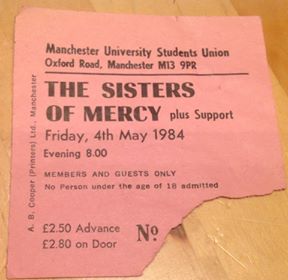
Up until recently, apart from the live recording, the only known ephemera for this gig was a double-sided flyer in the possession of top TSOM collector Bruno Bossier and kindly shared online (and reproduced again  here), until my own brother unexpectedly found his ticket from the show and passed it to me to share on the 8085 site. Other fans produced their own copies of the ticket from their personal archives, and some of those who had attended the show commented (e.g. Neil Kell: “Great gig!”, David Roberts: “Top gig!”) showing that once again, the band had managed to put on an excellent show despite (because of?) their over-indulgence beforehand. More recently Karolyn W who followed the band extensively in the Hussey years shared these photos of the gig, and Craig Adams’ complexion is particularly pallid on this shot. Whether his attire was his first-choice outfit for the show (nothing would surprise me given the extensively garish wardrobe of a band reputed only ever to have worn black) or a last-minute improvised effort, only Craig will remember (or, given the circumstances, possibly not).

     (pre- or post-vomit? A pale looking Craig Adams, Manchester May 4th 1984 - pic Karolyn W)

So only three days into the band’s first major label UK tour and a key instrument smashed, the fans vomited over and a member of the band in hospital for checks to a spine injury. Hardly the most auspicious start to the first major tour by possibly the most iconic goth line-up of all time, but nothing that a resounding victory by the band leader in a fencing challenge with support band (Flesh for Lulu) guitarist and future designer spectacle king Rocco wouldn’t cure. Oh, wait…


My thanks for their help with this gig are due to Karolyn W for sharing her photos on the 1980-1985 TSOM FB page, Phil Verne who curates that group, Bruno Bossier (also one of that group's moderators), Neil Kell, David Roberts, Denise H and of course Wayne Hussey for his fantastically revealing autobiography Salad Daze.

Wednesday, 22 April 2020

Leaders of Men - Joy Division and The Sisters of Mercy


Along with how they met and where they got the band name from, all emerging groups are always asked about their musical influences, as (lazy?) journalists try to pin down their sound for readers and potential fans, and The Sisters of Mercy were certainly no exception in their early days.

Andrew Eldritch (almost always the sole spokesperson for the band until the garrulous – and more experienced - Wayne Hussey joined the group in late 1983) had clearly anticipated the question, and kept a mental list of bands which he would trot out, perming any half a dozen from a list that included The Rolling Stones, The Stooges, Suicide, The Birthday Party, The Ramones, Motorhead, MC5, The Psychedelic Furs and Hawkwind, to name just some of the usual suspects.

Apart from the Furs and The Birthday Party, very few contemporary bands were mentioned as the singer deliberately tried to distance his band from any of the emerging “positive punk” bands, and interviewers comparing The Sisters to Bauhaus, for example, or any incarnation of The Cult were given very short shrift.

However, there was one very obvious comparison, a band whom the singer seemed reluctant to name-check in the 1980’s, but whose spectre haunted interviews and reviews of the band in the early days: Joy Division. There were some obvious points of comparison – both bands had reluctant but hypnotic frontmen, both singers sang in a low baritone, both had bass players whose buzzing riffs dominated their sound, both had a clinical, electronic drum sound, both came from and were resolutely based in the North of England, both favoured black record sleeves with no photos or details about the band, both built up fearsome live reputations based purely on word of mouth, and both played a mean live version of Louie Louie and of the Velvets’ Sister Ray. Both had ferociously loyal local followings built up by word of mouth, and knew where they were heading, maintaining some of the mystery essential for creating a buzz in the music scene, staying away from major label control. The Sisters early sound was dominated by the guitar of Gary Marx, who played a Shergold – a brand used by both Bernard Sumner and Peter Hook.

Surely an open and shut case, m’lud. That there were equally as many differences – whether in terms of influences, vocal tone, lyrical subject matter, use of humour and irony, guitar style and tone, song structure, visual image and band management and direction – seemed to matter little to those eager to pigeonhole TSOM as mere Joy Division copyists.

In the printed media, these comparisons were initially few and far between (to coin a phrase), but were discussed even in the breakthrough Sounds cover piece in December 1982, with Eldritch opining “The problem is these days that there are so few people who sing in a low voice…I mean, when I started singing people said “Ooh, he sounds just like Jim Morrison,” then shortly after it was “Ooh, he sounds just like Ian Curtis” and now it’s Pete Murphy.” Sounds was a particular guilty party, with a review of the Alice single saying that it was “more obviously JD-derived” , a phrase repeated by Geoff Barton when he made The Reptile House EP “joint single of the week” the following year, calling it a “deviant, JD-derived diabolism”. Keeping with the theme, the paper also including the (rhetorical question) “Is there a snatch of Ian Curtis?” in their review of First And Last And Always, by which time such comparisons were clearly redundant as the Sisters moved inexorably in the direction of Led Zeppelin and classic rock in the hats’n’dry ice phase which remains their visual (and arguably, musical) zenith.

With Richard “Mr Spencer” Newson (Sounds) and Adam Sweeting (Melody Maker) very much onside and getting decent copy published in their respective magazines on a semi-regular basis, the NME published only short reviews of live shows (normally when they had ostensibly gone to review another band on the bill) or singles, which were often less than flattering - ”Choked voice delivers indistinguishable..message” (Body Electric), “The singer looked like Joey Ramone and yelped like a dog” (“Christmas on Earth” gig review), “a bit too dense for extended listening” (Alice), etc.


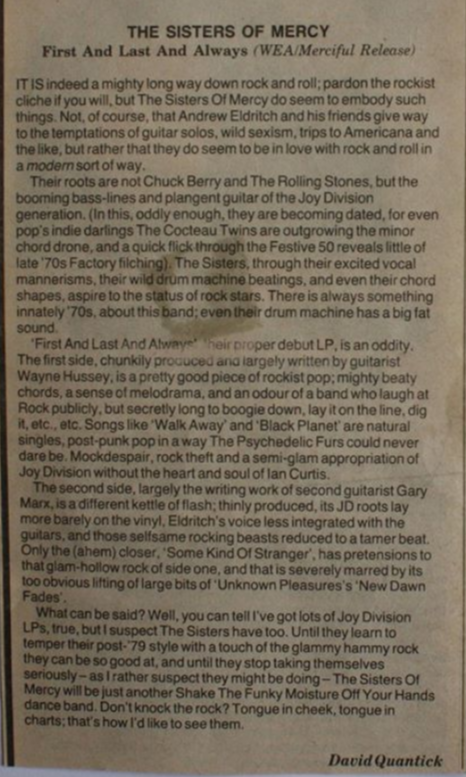
Already low on Eldritch’s Christmas card list, the NME further blotted their copy book with Paul Du Noyer’s major interview with the singer in March 1985, at a time when the band were being widely feted as the “next big thing”. “An exact definition of their appeal eludes me, but they do have something” was the best he could muster about a band who had surely earned their spurs as belated cover stars, a role given to hyped London-based bands often before a single musical note had been recorded! But this was as nothing compared to David Quantick’s self-congratulatory review the same month of First And Last And Always, which broke new records by referencing Joy Division no fewer than five times in four paragraphs, including in particular a reference to the similarities between New Dawn Fades and Some Kind of Stranger, which are not entirely without foundation, it has to be said.

The over-the-top nature of Quantick’s repetition of the JD reference was picked up on by Piccadilly Radio (ironically based in Manchester)’s excellent interviewer (Tony “the Greek”?) in a fascinating encounter with the band during the tour that accompanied the album release. The singer was only too delighted to expound his views on the NME’s failings in response, as can be heard in this extract kindly shared online by Phil Verne of the unofficial The Sisters of Mercy 1980-1985 Facebook fan group. “I think that they [the NME] feel about us the same way as they felt about Joy Division. It all happened up here, they missed out on it, they never quite understood it, they knew it was powerful, but they chose to ignore it and looked silly afterwards and that’s pretty much the same with us. I think they lump us in the same category because of that. They regard us as being northern and industrial and nothing we can ever do will change that because they just aren’t really interested in promoting rock bands from this part of the world any more than they ever were, I don’t think,” continued the exasperated singer at breakneck speed.

With the press finding new bands to persecute about their likeness to their musical forefathers (hello, Fields of the Nephilim) and focussing on the Hussey/Eldritch Sisterhood spat, the Joy Division comparisons receded and have not been heard since. With the passage of time, Eldritch has become more willing to talk about Joy Division and their occasional similarities to The Sisters of Mercy, such as in this 2016 seminal interview with John Robb: “I don't do cover versions. It's the same with Peter Hook.  He can't play any other songs at all and he has the best bass riffs other than mine.....That’s where Hooky [Peter Hook, Joy Division bassist] and me are the same – we just played up and down on one string and wrote songs. Me and Hooky have done the same thing since then. I loved The Stooges and Suicide and found myself in a band. I never saw them [Joy Division – who played at the F Club in Leeds] and if I did, I don’t remember it, but I loved the first album [Unknown Pleasures]. I had their poster on the wall. We were not to the side of Joy Division – we came from the same place as them. We were from the same place with The Stooges, Hawkwind and Suicide as the background and from a similar part of the world, with similar pressures on us, and it was kind of natural that we came up with something vaguely similar, emitting the [same] moody vibe.” The singer then intones a familiar “northern powerhouse” monologue which regular interview readers over the past four decades will be familiar with. “There were whole swathes of the country that were making that kind of sound – the Sisters called it the M62 sound, because the motorway that connected us to The Teardrop Explodes, Comsat Angels and all the other bands that we grew up with…that part of the country is narrow and we were on the same trains and buses and we were connected.”

The final word though must go to Geoff Barton of Sounds, whose review of what for me was The Sisters’ finest moment, The Reptile House E.P., ended with the following line: “If Joy Division drew blood. The Sisters cut right through to the bone. It hurts, but it feels so good.”

Tuesday, 7 April 2020

Vinyl Fetish record store appearance - Los Angeles, October 1983


This post is the 150th on this blog, which was originally intended as a way for me to note down and publicise for those who weren’t lucky enough to be there at the time, what life was like in Leeds in the early/mid 1980’s when The Sisters of Mercy were at the heart of the musical zeitgeist.

Before long, collectors and other old goths began to get in touch with their own memories and artefacts, with Phil Verne ultimately starting The Sisters of Mercy 1980 – 1985 unofficial Faceboook fan page, with the result that over the past few years we have managed to track down amongst other things full details of the band’s first gig, first single, first demo tape and first interview. What’s more, we’ve between us managed to confirm some new, long-lost dates on the band’s gigography of that era and eliminate other gigs for which some doubtful evidence had previously existed.


In the last eighteen months, the latter seam of information seemed to have been fully exploited, so you can imagine my delight when the picture above was shared on Flickr recently by US punk flyer specialist Superbawestside1980, referring to an apparent in-store appearance by The Sisters at legendary L.A. record shop Vinyl Fetish. The flyer appeared to refer to Sat 29th October, date of the band’s West Coast debut show at the Alexandria Hotel in 1983, recently covered by another post on this blog.

Eagle-eyed readers may have noted that Vinyl Fetish was one of the record stores where tickets for the Alexandria show had been available, and this clearly hastily-made poster, with crudely drawn time and date in tippex around a promo photo of the band, implied that the band would be making an in-store appearance at the shop in the Melrose area of LA at what for the band at the time would have been the ungodly hour of 1 p.m.

In the conversation in the comments under the flyer, Flickr user Riot Nrrrd had stated “Weird….I don’t remember this. Was this before their Halloween (?) gig at The Alexandria Hotel? I went to that.” Superbawestside1980 reassured both Riot Nrrrd and the reading public with the reply “Yep! It happened, and Henry actually took the time to film it and take pics as well. Who knows where that stuff is now although it would be great to see it.”

This whetted my appetite further – video footage of the first TSOM US tour has yet to surface, so this would be an amazing find, if only I could find out who “Henry” was. In true “online sleuth” mode, I begin to research Vinyl Fetish, finding a great blog post by a former employee of the store, Michael L Compton who wrote with real enthusiasm of his time working at the seminal record shop. “This period was the beginning of the dark Goth scene, and while many of those people were embracing the likes of The Sisters of Mercy, Death Cult and Sex Gang Children, they would come into the store and complain whilst I was playing my current favourites, such a Virgin Prunes and Einsturzende Neubauten…People seemed to accept it as part of the Vinyl Fetish Experience.” Compton had begun his post by stating that “Vinyl Fetish was owned and operated by two local scene makers named Henry Peck and Joseph Brooks. They were well-known in the Hollywood post-punk crowd for running several popular late-night dance clubs around town.”

                                (pic on Flickr by Patrick Houdek)

              The Vinyl Fetish premises still stand today and still host a record store (Google Streetview)

Eagerly googling Henry Peck, I was saddened to learn that he had passed away a couple of years ago, and read the very affectionate obituaries that L.A. Weekly, the L.A. Post Examiner and The Los Angeles Beat had published in honour of a genuine pioneer of the alternative scene in California, which remains one of the movement’s bastions to this day. There was also this excellent pencil portrait by Mark Vallen, showing a smiling Henry outside the store, with the description adding more local colour to the Vinyl Fetish story. “Henry’s establishment was quite a hangout, with every punk (or curiosity seeker) in LA dropping in at one time or another. You could buy weird clothes, browse the hundreds of offbeat records – or just watch the never-ending cavalcade of humanity.”

This was exactly the kind of uber-cool shop that I can imagine Eldritch and co hanging out in, harking back to the singer’s days at Priestley’s in York at the start of the decade as he started up his band. The Sisters had certainly not yet reached the point in 1983 where they were in demand in the UK for in-store signing sessions, so this appearance would have been a new “first” for the band. However, with Henry’s passing, it seems as if the evidence of this momentous event would also have been lost forever.

As a final attempt to find out more about the event, I decided to track down Peck’s former business partner Joseph Brooks, which proved to be surprisingly easy as he has become one of America’s most collected celebrity jewellers, with clients including Madonna, Siouxsie Sioux and Samuel L Jackson. Clearly a highly busy and successful man, so it was without much hope of a reply that I emailed Joseph Brooks with a plea for more information.

However, I was astonished when he got back to me within five minutes! He told me that there was “really not much to say about it….Henry and I were the DJ’s for the Alexandria Hotel show but the band cancelled the Vinyl Fetish appearance. That night they came to our club called Fetish….Andrew just stood in the club watching people dance….I never really got to know him at all.”


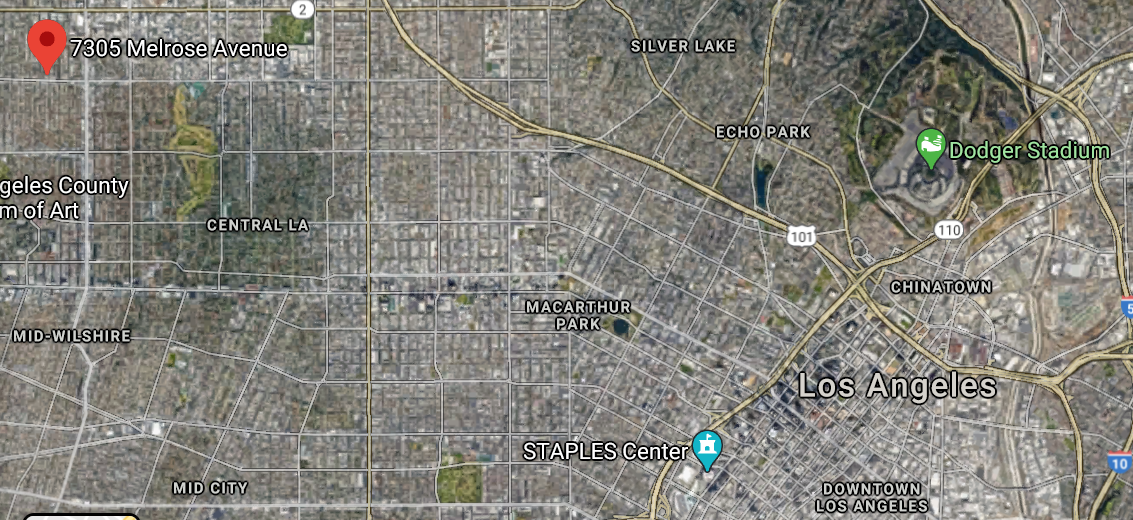
Whether it was the early start, the distance between the Melrose Avenue store in Hollywood and the downtown Alexandria Hotel (see map above) or that the band had found other distractions on their first visit to L.A., the in-store appearance therefore didn’t take place, and Andrew’s image as a rather diffident conversationalist with those he didn’t know well accompanied him on a visit which was clearly in fact inspirational to him. The fact that the in-store appearance was in fact cancelled was confirmed to me by The Sisters of Mercy's premier unofficial expert on the band's history in the US, Trevor R, who told me that he had spoken to others who were in L.A. at the time and that they had told him that it did not take place.

Therefore the band's first known and confirmed in-store appearances are still those on the tour in support of the release of First and Last and Always in March 1985 when they visited stores in several towns, including HMV in Leeds, and the legendary Selectadisc in Nottingham (see photo below, courtesy of mega TSOM collector LG).


But if anyone does know anything about the video footage of the band from this visit, please do get in touch!


I would like to thank Superbawestside1980 for sharing the flyer on Flickr, LG, Phil Verne, Trevor R, Michael L Compton for his informative blog, and in particular Joseph Brooks for helping to elucidate events surrounding The Sisters of Mercy’s first visit to L.A.

Sunday, 8 March 2020

First And Last - Strathclyde University, 9th March 1985


After what seemed an interminable wait (extended by the sound mixing issues and personal health problems which meant that the planned release to tie in with what then became the Black October tour never materialised), The Sisters of Mercy finally unleashed their debut album First And Last And Always on March 11th 1985. Although the tour which started two days previously was officially called “Tune In, Tune On, Burn Out” (an adapted quote from 60’s hippy guru Timothy Leary), the Strathclyde gig was certainly a perfect fit for the First and Last aesthetic:


- The FIRST gig of the crucial year of 1985.
- The FIRST live outing for key tracks on the FALAA album.
- The FIRST gig where Eldritch wore his trademark hat on stage, a key part of the band’s visual image.
- The start of the LAST tour with Gary Marx, who left after the final UK gig at Brighton on April 1st (although he did appear on the Old Grey Whistle Test recording the next day).
- The start of the band’s LAST set of live shows of the 1980’s.

However, mention the Strathclyde ‘85 gig to any obsessive TSOM fan and they will think of two things: the extra-long soundcheck, a poor quality audio recording of which exists and is well-known to collectors, and the eye patch which Andrew Eldritch sported during the gig. The latter was not some piratical affectation, but the essential consequence of an incident that had allegedly taken place the day before in Leeds. The singer is of course entitled to his privacy, so I have not researched any further the rumours printed at the time that the injury resulted from an altercation regarding a dispute with a jealous boyfriend, but Eldritch referred to the very obvious white bandage which he was sporting in the customary inter-song banter. “My vision’s a little blurred tonight,” he said. “I’d like to say thanks to Carol for the glasses” [is he referring to his customary shades or is it an ironic reference to a “glassing”?] “I spent the night in Casualty”. He pronounced the final syllable of that last word in a very obvious attempt at a Leeds accent, pausing briefly before it and pronouncing it “teh” , the only time I can recall him imitating the Loiner drawl on stage. Eldritch allegedly sported the bandage over his left eye at the following night’s gig in Edinburgh too, making photos from these gigs particularly easy to identify, such as these examples of Glasgow kindly shared on FB by Douglas G and Gyongyi. [The known photos of the Edinburgh gig are taken from the wrong side of the stage to see whether or not this was the case, so if anyone has any further pics, it would be great to see them.]


Pic shared by Gyongyi


Pic taken and shared by Douglas (Choque H pointed out that a ghostly Gary seems to be symbolically heading in a different direction to Andrew)


In the years since this gig, fans have gradually been able to piece together the events which took place between the end of the European tour of November 1984 and the March 85 UK tour: Eldritch’s recuperation in Italy, the singer working independently on the b-sides to the No Time To Cry single (which was released the day before the Strathclyde gig), the wrangling over the mixes to be used on FALAA, etc. In all likelihood, the band would have had precious little time for rehearsals, which would explain the 45+ minute soundcheck, longer than many of the actual gigs of the previous iteration of the band in 1982/83, whose recordings would fit snugly on one side of a C90 cassette (to the delight of bootleggers everywhere).

The soundcheck is notable for a couple of snippets of songs which weren’t ever played live by the band. Phil Verne of the 1980-1985 The Sisters of Mercy Facebook fan group kindly shared this extract on Soundcloud which features Wayne Hussey sketching out the riff to what would become one of the early tracks on The Mission’s major label debut God’s Own Medicine, Bridges Burning. Hussey had worked on a whole selection of new songs which Eldritch would reject for The Sisters, and clearly this would be a factor in the ultimate break-up of the band, and here he picks out the distinctive Bridges Burning melody as the group improvise whilst they tune up, after (Gary has played?) a section of Abba’s Gimme! Gimme! Gimme!. Doktor Avalanche then strikes up the familiar Ghost Rider loop, enabling the band to tune/warm-up further in a more organised but still improvised manner. Further improvisation follows, including the riff from Fleetwood Mac’s The Chain amongst many other little riffs (including Burn) on various instruments before Eldritch finally joins in for the more traditionally structured songs, starting with Stairway to Heaven, which is significantly longer here than the well-known encore version which went straight into Sister Ray after the first two verses. It was clear that by 1985 the band was more focussed on Led Zeppelin than on, say, The Ramones, as they had been at the start of their career when they had been as much a punk as a rock band. As the soundcheck continues, the band continue to warm up simultaneously but independently, with fragments of the likes of Purple Haze, No Time To Cry and Stop Draggin’ My Heart Around all competing for dominance at one moment. Eventually the Doktor again brings an end to the cacophony with the opening salvo of what is an excellent run through of then current single No Time To Cry, the first formal song performed (some twenty minutes into the soundcheck), even if Eldritch misses out a few sections. 

The singer then reverts to his a capella version of Stop Draggin’ My Heart Around, which is rudely interrupted by the opening bars of Train, with the band again sounding really tight from the opening chords, and the singer deigning to sing the full song this time. After several minutes of animated but sadly mostly indecipherable discussion between the band, the E-bow is dusted down and the familiar whooshing sound can be heard over the PA as after a brief Doktor false start, the familiar haunting strains of Marian can be heard. Eldritch’s voice is particularly low in the mix, with the Doktor’s dull thud and the E-bow’s mournful wail initially dominant, although the balance is significantly better by the German section. After further improvisation typical of the tuning up between songs of any of the band’s live shows of that era. The final bit of the soundcheck is the most fascinating, with Eldritch having a third unsuccessful attempt at getting the band to accompany him on Stop Draggin’ My Heart Around, but this time the Doktor doesn’t even wait for him to finish his stanza, and Eldritch is still singing the Stevie Nicks number over the entirety of the introduction of Burn, which the rest of the band are playing full-on, only switching to the correct song at the very last moment. Those who like to read a lot into these things (guilty as charged, m’lud) might see this as symptomatic of a band whose members were pulling in different directions. However, the soundcheck ends with a great abbreviated version of Louie Louie featuring just Eldritch on vocals and Adams on bass. Job done.

And so on to the gig itself. As with some previous posts, this review of the gig was written by Sisters expert Ollie C, to whom I am very grateful:

So, thanks to Nik's introduction we can focus directly on the setlist. As the last tour was just about three months previously, the setlist is not changed completely. A few old classics are kicked out ("Heartland", "Anaconda" and "Adrenochrome"), and instead we get some more songs from the album, some of which had already been played on the "Black October" tour. So the crowd is familiar with "No Time To Cry" (released as a single two days before as well), "Marian", "A Rock And A Hard Place" and of course "Walk Away". Probably the most notable change for this "blueprint" of all the upcoming gigs, including the last one in the Royal Albert Hall, is the opener.

As new opener the Sisters chose the title track of the album. This was a tough decision, as it had never been played live to an audience before: to start a gig with a premiere is quite a challenge for both band and fans...as a band, you feel more comfortable playing a song live for the first time after you have been warmed up a bit after a couple of songs, while of course the audience is confronted with unknown material, so you can't be sure how the crowd will react.   

Unfortunately, I only can judge by listening to this 35 year old recording what kind of effect this track had on the audience. If I try to imagine having witnessed this and hearing this track for the very first time, I probably would have been impressed by the long Doktor's four to the floor intro giving it a trance-like prelude, then Gary's guitar kicking in with maybe his most legendary guitar riff, this kind of celtic-sounding melody which probably gave it the working title "The Scottish One" before it was finished. Craig and Wayne join one by one to form the foundation for Andrew's vocals, which are a bit low in the mix for the first seconds, but this is corrected quickly. This very song is a perfect example of the typical Sisters sound of this era. The main melody is carried by Gary (who wrote it), while Wayne adds some more complex riffs and chords. Wayne also uses a kind of slow morphing flanger effect which adds a kind of psychedelic feeling. Craig drives his bass as usual, but also starts to play some more melodic stuff. The Doktor changes into a glopping groove that honors his name. So, in good mood and shape, "First And Last Always" is performed very powerfully, the guitars sound fresh and clear, and Andrew's voice is very strong and even delivers some high sung notes, not typical for later versions of the song. So, the premiere was fulfilled par excellence. And, if we go back to the question why this song has been chosen as the opener, to me it works so fantastically well that it can be regarded as probably the best opener ever (OK quite a personal opinion, and to be fair "Kiss The Carpet" gets very close ;-) )

The set goes on with both sides of the first WEA-single "Body And Soul" and "Train", followed by three tracks off the album in a row, all from side A and so all Hussey compositions ("Marian", "No Time To Cry" and "Walk Away"). These work well together and fit perfectly in the set, showing the direction the album takes on side one. Then we move back to some 1983's classics ("Burn" and "Emma"), both appreciated by the audience. With the following "A Rock And A Hard Place" the first side of the album is finished for this set.

What follows is the second premiere for this evening (and unfortunately the second and last song played from the second, "Marx" side of the album...("Possession" will be played the next day). We get the first ever performance of "Amphetamine Logic". The crazy thing about it is the title. To choose a title that shows your drug abuse so obviously is kinda naughty. In fact the complete title didn't make it on the album cover, due to distribution fears. The lyrics leave no room for misunderstandings regarding what the song is about.

After Eldritch's introduction and the first steps of the Doktor the song starts with a riff by Gary, who will again carry the whole song with his theme, Wayne again adding some real rough and razor-sharp chords during the verse, changing to some really thrilling staccato-like high notes in the chorus. Andrew sings his lines very close to the recorded version, preparing the audience and himself for the climax, that is of course the end of the refrain when he, backed by Wayne, gets to rise his voice an octave higher to present us the final words closing the song, nearly getting out of breath, the screamed "Give me my Speed". Well, to me, this premiere is also delivered very well.
The time for new songs or surprises is now over, we are now back on track for the setlist played the tour before, which means we get a firework of old classics ("Floorshow", "Alice", "Body Electric"), then finishing the main set with "Gimme Shelter". The songs are all well-played and the band seem to be in a good mood, which is a good sign for the upcoming encore section. The first one "Knockin’ On Heaven's Door" is always welcomed and is played here in a nice version with even some improvised parts from the vocals here, accompanied by Wayne's typical guitar solo.

The second and final encore is the highlight for many fans, and probably for the band as well. Nobody ever knows if it's going to be "Sister Ray", Ghostrider", "Louie Louie" or a combination of two or three of them. I wonder how the decision was made. Did they go backstage, take some refreshments and someone suggests "Hey, let's do Ghostrider/Sister Ray" or "Louie Louie" or what else now??? Or was it decided on stage after the Doktor's groove started??? I would be very interested if someone has an idea about it.

Well, tonight we get "Sister Ray/Louie Louie" for a very pleasing 10 minutes, that show the band in a great mood, having fun in improvising. It sounds if they are enjoying playing together after a break, feeling relieved maybe they successfully went through the first gig of the new tour and the new songs went well... so why not play some dirty Rock'n'Roll? Wayne's flanger effect gives the whole thing a Hawkwind-like space-rock feel, while Andrew has fun with some improvised screaming parts. Of course the medley ends in a cacophony of the hammering Doktor and droning guitars, with some final screams. A perfect ending for the first date of the tour!

Thanks, Ollie!


The Strathclyde University venue was one arguably the highest the band ever played, being situated on the eighth floor of the University Union building. The Union still stands today in the very heart of Glasgow, but they sadly no longer put on gigs, which is a shame given the recent fire at the nearby 02 where The Sisters played as recently as 2015, their most recent gig in Scotland. Back in 1985, like most Students Union buildings in the UK, licensing laws meant that only members could be admitted, with the result that many people couldn’t initially get into the gig. Sisters fan Rob C was at the gig (as indeed he has at every Scottish gig the band has ever played) and recalls, “I don’t think Eldritch liked this and it got sorted.” This had also been the case the previous year, an event recorded in this preamble to an interview in Scottish fanzine Deadbeat in 1984.


Like so many who witnessed the band that year, those who did manage to get in to the Strathclyde gig thirty-five years ago saw a band at the forefront of the musical zeitgeist at the beginning of the end of what for some was the first and last great era of The Sisters of Mercy.

My thanks for this post are due to in particular to Ollie C and Phil V, as well as Douglas and Gyongyi for the photos, and Choque, Rob and others for their comments. I would also particularly like to thank Alan for sharing an excellent new audio source of the gig. Those who are interested in finding our more about the gig are invited to join the debate and discover further artefacts in The Sisters of Mercy unofficial 1980-1985 fan page, expertly curated by Phil V.


Sunday, 26 January 2020

Gnome Time To Cry - Zurich, 26/4/1985


When The Sisters of Mercy arrived in Switzerland for their first ever gig in the cantons towards the end of April in 1985, one can easily imagine their state of mind. The first leg of the gruelling Armageddon tour was now behind them, with ten gigs in Belgium, Holland and (West) Germany completed in the past thirteen days, their first as a three-piece after Gary Marx’s departure, so there must have been a palpable sense of relief. This was evident a few days beforehand when Wayne Hussey had taken part in a phone interview with a Swiss radio station, where he discussed how well the band were coping with him as sole guitarist, to the extent of the very strong likelihood that Gary would not replaced. Wayne was even compos mentis enough to correct the radio DJ on the date of the forthcoming Zurich gig.


The Zurich gig (advertised on Swiss copies of FALAA by this sticker, from the collection of LG) was very much in the middle of a brief lull in the middle of the touring schedule being the only gig in a four day spell between gigs in Munich and Milan, with  a further dozen dates in sixteen days in Italy, Germany (again) and Scandinavia to follow (tour book extract courtesy of Graeme Salt who shared it on the TSOM 1980-1985 FB group). One can imagine how relieved Eldritch and co must have been to see the words "Band and crew: NO TRAVEL". 


The band certainly seem to have been in relaxed mood during interviews around the gig, with a further Swiss radio interview featuring all three remaining members also broadcast and with this presumably also being the venue for Judith Ammann’s interview with Eldritch which featured in her 1987 German language book of interviews with post-punk acts, Who’s Been Sleeping In My Brain? (Ammann being originally from Lucerne).

The interview focusses on the lyrics of two of the tracks on the recently released debut LP, No Time To Cry and Possession. A live version of the latter was one of two tracks (Body and Soul being the other) which have been widely bootlegged from the gig at the Zurich Volkshaus on Friday 26th April 1985, featuring on both the Echoes series of LPs and the Acid Rain 12”. Eldritch, clearly tiring of touring and feeling overwhelmed by the responsibilities of the figurehead position which he had rapidly attained, speaks with great candour about the “Possession” lyrics (the Zurich version of which has been kindly uploaded to Soundcloud by Phil Verne of The Sisters of Mercy 1980 – 1985Facebook group) in the Ammann interview.

Lines in the song such as :

I'll be your imagination
Tear apart what you believe
Make a mess of your conviction
Take away my pride and leave
Nothing, but the debris
Cuts, two ways.

take on extra meaning in the context of Eldritch’s comments in reply to Ammann who had asked him if he felt like a screen on which the audience projected their own dreams and desires that were not a true reflection of Eldritch himself. “Not if you play the game the way I do,” the singer replied (if my approximate translation of the German is correct). “Our song Possession is about this very subject. I’m simply trying to show an image of the relationship between the writer, the singer, the song and the audience. If singers and audiences continue to insist on sticking to their roles as they are normally understood, nothing remains [after the end of the song].” Ammann asks Eldritch what he IS trying to project, eliciting the answer: “I'm just trying to be a responsible puppet for other people’s emotions; no matter what you try to represent, this is what it always comes down to. That's what the audience demands and understands …It can be soul-destroying. Sometimes you almost feel contempt [for the audience]. In this particular song [Possession] I was trying to say: Please don’t trust me too much, because this is still me [Andrew] and not something that you want to see in me. Be careful, because if you trust me even more, I may just become what you want to see in me, and that won’t help anyone. So there’s this balance between contempt and the responsibility that anyone feels when standing up there and singing about pain. That's exactly what we sing about.” This probably helps to explain why the vocal on the FALAA version of Possession sounds particularly raw, as Eldritch strove to convey the extent of his emotion on the issue, rather than the more polished and enhanced vocal on most of the rest of the band’s canon.


But back to the puppet show. Possibly as a result of the radio pre-publicity, the fact that it was the band’s first ever show in Switzerland, and this rather fine and unique advert for the show which appeared in Swiss magazines, the show at the Volkshaus was very well-attended, as can be seen in the wonderful contemporary photo below ((c) Sonja Flurry)  According to reports from those who were there, it wasn’t just the cramped audience conditions and the apparent heat (see the sweat on the face of the Jordan Pickford lookalike at the bottom right of the photo) which made the gig an intense experience for those in attendance, but also the sheer volume at which the band played that night.

Tom G Warrior of contemporary and highly influential Swiss “extreme metal” band Celtic Frost (and therefore something of an occupational expert in loud concerts) was at the gig, and spoke about it in an interview with The Quietus’ Jimmy Martin in 2017. “I saw The Sisters of Mercy with Martin Ain from Celtic Frost in Zurich in April 1985 on the tour [for FALAA]. It was the loudest concert I’ve ever heard in my life. It was so loud that you had to leave the hall periodically because it was so painful. But at the same time we witnessed something that we had never witnessed before. When we stood there and we saw Marian and …First And Last And Always live, with that heaviness, that darkness, that volume, it was amazing.”


Blogger JHG Shark was also at the gig, and also found it a unique experience amongst the many shows catalogued on his website : “It was a strange gig, because people screamed and whistled between the songs, but there was no applause! I’d never experienced anything like it. I don’t think it was because of the band’s sound or the show on stage, it’s just how Sisters fans were. I personally really enjoyed the gig, even though the sound was thinner than on the record.” [This could of course be due to the fact that there was only the one guitarist, with Marx back in West Yorkshire] “After the gig I had to go to the Big Apple Club to do my DJ shift. The Sisters and some of their fans also found their way to the club, and some fans requested that I play a few TSOM tracks. I thought, “No way,” and just played the usual records. Eventually, the members of the band got up to dance … and to the great astonishment of all their fans present, they were dancing to… SIMPLE MINDS”. Sadly no video evidence of this event has yet surfaced…

The gig itself was however recorded by several attendees, and listening to a copy of the show (kindly provided to me by Phil Verne of the TSOM 1980-1985 Facebook fan group) the volume issues and the strange atmosphere are immediately apparent. Doktor Avalanche is incredibly high in the mix, the beats bludgeoning the senses, and this is probably the only gig of this era I have heard where Eldritch doesn’t utter a single word during the entire show between the songs, save for the title of the next number. The Volkshaus acoustics are particularly effective on Body and Soul, with Hussey’s guitar reverberating around the arena, whilst the thin-ness of the guitar sound is all too apparent on Walk Away. Hussey makes a guitar pitch error during his “No…No…No…” backing vocals section on No Time To Cry, but Eldritch makes an even bigger gaffe on Amphetamine Logic, coming in two lines early and singing the chorus over the verse backing, leaving Adams and Hussey to play the chorus as an instrumental on the first play-through. The singer was in notably finer form on Emma and Marian, and the recording ends with the best live version which I have heard of Train, sadly and suddenly curtailed on this copy of the recording. 


So a distinctive as much as a legendary gig in one of the more attractive venues on the tour (pic above, credit Wikipedia) and one which I'm pleased to report is still going strong today (as is the Seegarten Hotel where they stayed, now charging around £175 a night for a standard double room - the band had clearly arrived!). Having originally opened back in 1910, The Volkshaus’ 1200 capacity hall hosted recent gigs for As I Lay Dying and Vampire Weekend amongst others, but many bands, including TSOM, now play at the city’s “Rote Fabrik” (“Red Factory”) instead.

My grateful thanks for this post are due to LG, to Phil Verne of the TSOM 1980-1985 Facebook fan group, to Graeme Salt, to JHG Shark and all others who have contributed.

Sunday, 5 January 2020

The Sisterhood - interview with Lucas Fox


Lucas Fox was Andrew Eldritch’s right hand man on The Sisterhood project in 1986, helping the Sisters’ vocalist to rush-record and release the Giving Ground single to wrest control of The Sisterhood band name from Wayne Hussey and Craig Adams, and then working on the follow-up Gift mini-LP, a remastered version of which is due to be re-released on Cadiz Music in 2020. Fox, who famously was Motörhead’s first drummer before also being a founder member of London punk band Warsaw Pakt (whose only LP was released within twenty-four hours of being recorded in 1977 – a useful experience for the Giving Ground project!) and a touring and session drummer and producer for countless other acts before supporting The Sisters as a temporary member of The Scientists in 1985.

Thereafter Fox relocated to France where he became a well-respected industry figure,  resurfacing as a musician when drumming on the Pink Faeries’ new album for Cleopatra Records in 2018. Now writing his musical autobiography, Lucas Fox gave a series of interviews last year in which he spoke in some detail about his involvement with The Sisterhood (notably in this Croatian interview) amongst many other projects, and when his old friend and music paper lensman Tony Mottram kindly suggested to The Sisters of Mercy 1980-1985 Facebook fan group administrator that he would be happy to pass on any questions to Lucas Fox, I jumped at the opportunity to find out more about one of the most fascinating periods of both his and Andrew Eldritch’s very different forty year musical careers.

Lucas very kindly provided full answers to my questions below, which help to confirm many aspects of The Sisterhood project and to add some extra details in places. I am very grateful to Phil, to Tony and of course to Lucas, and hope that you find the latter’s answers as interesting as I do.


NVL: What can you remember of when you first met the Sisters?
Lucas Fox: We were based at the same office Ladbroke Grove in London. Like other Gothic bands of the time they wore only black, as did I.

NVL: What were your first impressions?
Lucas Fox: Andrew was austere and aloof, but Wayne and Craig and I got on straight away. Andrew and I warmed to each other as we got to know each other.

NVL: Eldritch has often stated that he was a big Motörhead fan – did he regularly grill you about your time in the band?
Lucas Fox: Not “grill”… but he would ask questions about Lemmy occasionally - about sulphate consumption,  about our musical interests when we (Lemmy and I) started the band…

NVL: Could you hear much of a Motörhead influence in the Sisters’ sound?
Lucas Fox: Not really. There were/are far more dynamics in the Sisters’ song arrangements. At full tilt there are some likenesses, but I couldn’t really say that I see a lot of influence.

NVL: Eldritch drummed on the first TSOM single but has employed a drum machine ever since. Did you often discuss this issue with him, the merits of human versus machine?
Lucas Fox: After he’d seen me play with The Scientists and knew I’d been producing. My drumming style with The Scientists intrigued him and I think he had a yearning.

NVL: When you toured with The Sisters as last-minute replacement drummer for the Scientists, was that your first major tour for a while, as it was seven years since Warsaw Pakt split up?
Lucas Fox: I worked with Carl Groszman’s White Lightning, recording and touring, with SPYS (same), Walking Wounded, Freddie “Fingers Lee”, Fools Dance (Simon Gallup of the Cure)… I played, recorded and toured with Martin Stephenson (& the Daintees)... and many sessions..

NVL: Were you aware on the Scientists’ tour with The Sisters that the band was on the verge of splitting up?
Lucas Fox: No

NVL: When you were asked to join the Sisters for Knockin’ On Heaven’s Door [at the Brighton Top Rank gig on April 1st, 1985), was that pre-planned, or just a last-minute spur of the moment thing?
Lucas Fox: On the moment, it was Andrew’s idea.

NVL: That gig was Gary Marx’s last show with the Sisters. Did you know that this would be the case at the time?
Lucas Fox: No, I didn’t.

NVL: Was it a surprise when Andrew contacted you to work at the beginning of 1986 to work on the Sisterhood project, or had he already mooted the idea the previous year?
Lucas Fox: No, it was a reaction to Wayne & co wanting to use the name Sisterhood (the Sisters fan club)...

NVL: As you may be aware, Andrew has the reputation of being something of a perfectionist in the studio, and some have found him difficult to work with as a result. How did you find him in that regard?
Lucas Fox: Complicated, fascinating, sometimes difficult, always obsessive...

NVL: Were you aware of the importance of rush-releasing the “Giving Ground” to secure the band name and the publishing deal advance when you were recording the song?
Lucas Fox: Yes, but not the publishing advance part.

NVL: Was there a lot of pressure?
Lucas Fox: Well, I just went for it as usual.

Was the atmosphere different when you went to Fairview to record “Gift”?
Lucas Fox: Yes it was just me and Andrew and Roy the engineer for 6 weeks, only at night, apart from when James Ray or Patricia were there.

NVL: Were the songs in a fully finished form and it was just a case of recording them, or were they basic ideas which were then worked out in the studio?
Lucas Fox: Most didn’t exist at all!

NVL: Were you surprised by the content of The Sisterhood material, which was very different to The Sisters of Mercy’s output?
Lucas Fox: No, it was still obviously Andrew’s work and style.

NVL: Have you listened back to the album much since?
Lucas Fox: Yes, quite a few times.

NVL: Did Alan Vega visit the studio or did he contribute via tape ?
Lucas Fox: No, it was by tape.

NVL: Was there any other times subsequently when you worked with Andrew?
Lucas Fox: No, just the mixes at Eel Pie [Pete Townshend’s studios in Twickenham near London] after the sessions at Hull.

NVL: More recently, The Sisters of Mercy have covered Motörhead’s Capricorn and Larry Wallis’ Police Car in live shows. Have you heard either of them (easily findable on YouTube) and if so, what did you think of them?
Lucas Fox: No, I must listen to them!

NVL: Where do you rank The Sisterhood in the various musical projects you have been involved in over your career?
Lucas Fox: As a very interesting project.

NVL: You drummed on some old Motörhead songs at a show with a Greek tribute towards the end of 2019 ….
Lucas Fox: Yes, it went fabulously well, hundreds of autograph signings (+selfies etc) and I got to play 3 Motörhead songs that hadn’t been played in that version since 1975, an awesome experience! Greek metal fans are great and know all the words ...

NVL: And would you like to work with Eldritch again one day? Are you still in touch with him?
Lucas Fox: Yes, I wouldn’t mind but I can’t see it being likely, and no, we’re not in touch.

Thanks again to Lucas for his reminiscences of a facinating time in TSOM history. Keep an eye out for his musical autobiography which will be a wonderful insight into the early days of metal, punk and goth!