Thursday, 14 April 2016

The first "Alice" ? Zig Zag Club London July 1982

By the summer of 1982, it was clear that Andrew Eldritch’s masterplan was beginning to take shape. Ben Gunn had been recruited, the second single (Body Electric/Adrenochrome) had eventually been released on CNT to positive reviews and regular plays on John Peel, and the band were beginning to pick up some decent support slots that included the likes of Nico and (allegedly) The Clash, exposing them to a wider range of industry figures and audiences than possible in Leeds.


Sadly, not much has surfaced from most of these gigs, with the exception of the gig at the Zig Zag Club in London on Saturday 10th July 1982, where TSOM played as support to The Birthday Party alongside a group called Play School of whom I have found no further information. They were listed in both this magnificent pink flyer (the property of generous collector LG) and this advert from that month’s Zig Zag magazine (photo courtesy of Tony P who runs an Appreciation page for the magazine). 


Headliners The Birthday Party were a band for whom AE had expressed admiration earlier in the year in an interview with Melody Maker’s Adam Sweeting "We're not as good as Motörhead but we're better than The Birthday Party. That makes us pretty damned good." Unfortunately, Eldritch’s rosy-eyed view of The Birthday Party was not reciprocated, as this seemingly irony-free recounting of a story from Ian Johnston’s book “Bad Seed” will testify :  “The support group were the then little known Leeds Gothic rock band The Sisters of Mercy, fronted by the enigmatic Andrew Eldritch. 'At the end of their set Mr Eldritch and friends wanted to know what The Birthday Party thought of them, and asked me to find out,' recalls Chris Carr with a wry grin. ' I asked them if they were sure about this, they were, so I went off to the dressing room. The only person who saw anything of their show was Mr Mick Harvey, who announced that The Sisters of Mercy were the worst band to have ever supported The Birthday Party. I went back and recounted this to Mr Eldritch. The following Monday I got a call from The Sisters of Mercy saying that the band had had a meeting and had decided to continue, and to wish The Birthday Party all the best in the future. They understood their criticism but thought rather than break up, they'd carry on. it was all very dramatic.' Carr laughs. Within six years The Sisters of Mercy would become one of the UK's most successful rock groups.”

Listening back to a recording of the gig, one can only assume that Mr Harvey’s comments were motivated by jealousy. The gig opens with a historical gem, the earliest known version of “Alice”, which features a very tinny intro and a slightly different opening riff, and a more metronomic delivery from Eldritch, as the band’s sound echoes around the former cinema, as can be heard on this extract kindly uploaded onto YouTube by live cassette aficionado Phil Verne. Gary’s riff grinds to a halt at one stage, but the band keep going and follow on with Floorshow, Eldritch introducing the band “We are the Sisters of Mercy” and then screaming “Floorshow” (rather too loudly) over the familiar buzzing intro, singing the first verse an octave higher than usual. Floorshow too retains its earlier simplified guitar riffs, but the band have now hit their full stride and a wild “Watch” follows on, Eldritch’s Stooges and Furs influences apparent on extended “Watch us fall” sections. “Body Electric” sees the band pick up the pace further, the then single being faithfully rendered, albeit with another slightly pitchy vocal from a clearly nervous Von when he switches to his upper register for the second half of the song. Showing an increasing ability to pace a set, the band then launch into a note perfect version of “Lights” (still almost a year before it would appear on vinyl), before a scream filled “1969” and a suddenly truncated “Sister Ray” bring the support set to a close. With what sounds like a healthy sized crowd cheering for an encore, Von is forced to come back on stage to thank the crowd for their support but explain that there was no more time, “so as Morrison said, “this is the end”, see you guys soon. Good night.” Immediately, the rather nasal DJ takes over and says “Thanks a lot, The Sisters of Mercy, sorry there’s no more time but coming next tonight, The Birthday Party. Now a video …”


The Zig Zag Club had been set up by the well-known music magazine of the same name, which by the early 1980’s had increasingly become interested in the growing post punk scene, and decided to branch out into club management. The terms of their licence meant that everyone attending was supposed to be a member of the club, although an associate membership could be bought along with tickets (even on the door) to get round this issue, and this example comes from fromthearchives.com.


The ZigZag was housed in the former Grand Cinema on Great Western Road in London’s Westbourne Park district, which had opened in 1912 with a seating capacity of approx. 1250. The auditorium was destroyed by German bombs in the Second World War, but the original art deco façade (seen in this magnificent 1930’s picture on the "cinema treasures" website) was maintained when it was rebuilt in the 1950s as part of the Essoldo chain.


After a brief period as a Bingo hall, it was relaunched as the ZigZag club in April 1982 in what turned out to be a short-lived affair, as the club had closed again by the end of the year and was infamously squatted by Crass that Christmas for a free gig which still gets anarcho-punks misty eyed. Sadly, after a spell as a rehearsal space, dereliction took hold and the cinema was demolished in 1994, its place taken by a block of modern red and tan coloured flats. 


Intriguingly, another gig listed on contemporary announcements features TSOM billed as support to Dead or Alive, then of course featuring one Wayne Hussey on guitar in their pre-disco phase. Sadly, no further evidence has yet surfaced to suggest that this gig was ever played by the band, although the Sisters did increasingly come to see their London gigs as their chance to take further strides in the industry, despite all their fanzine protestations that this was not strictly necessary for a provincial Northern band determined to “make it” on their own terms.


My thanks are again due to LG for his help with this gig, being the source of the pink flyer and the gig adverts which have now been circulating for some time, and to Phil Verne for allowing me to hear his recording of the gig, one of the earliest of the band outside of their native Yorkshire, and for sharing with us all his YT upload of the earliest known version of "Alice". Thanks too to Tony P for the ZigZag extract.

More Ben Gunn era gigs coming soon - if you were at any not yet covered, please get in touch !


Monday, 4 April 2016

The incredible untold story of the first TSOM gig abroad

At the Sheffield University gig in June 1983, to fill the time between songs as the band struggled (not for the first time) with a combination of the difficulties of keeping two guitars in tune with each other and of operating an increasingly recalcitrant drum machine, Andrew Eldritch can clearly be heard engaging in a bit of banter with the loyal Yorkshire following. “Who’s coming to Europe with us ?” he enquires, eliciting cheers of approval.
One wonders what the gig schedule looked like at that stage, as it has been the work of many aficionados and three decades to re-create such a list. As we established in a previous post, it was only comparatively recently that the date of the Mallemunt Festival in Brussels was definitively established as 5th August 1983, installing it as the band’s first date overseas.

Incredibly, however, more recent research by legendary TSOM archivist LG has revealed that TSOM played much further afield a week earlier than the Belgian date, in the historic Italian Adriatic port of Ancona. To my astonishment, LG had acquired a poster listing TSOM as playing in the Italian town on Sunday 31st July 1983, billing it as their “unica data” and “primo concert in Italia”.

The port of Ancona had a long-established musical festival which tended to draw an older audience, but in the early 80’s municipal funding was made available for the production of an alternative version, Parkingang, to be held in the historic Piazza del Plebiscito, a beautiful traditional square complete with mediaeval town hall with clock tower, baroque church, and restaurants whose terraces spilled out over the cobbled interior.

Incredibly, at a time when punk musicians had been harassed and almost driven to extinction by UK authorities, in Ancona this alternative festival was entrusted to a collective comprising a local video art group, “Video Pallidi”, who planned to show early alternative films (Man Ray, H. Richter etc) and local punk bands Cracked Hirn and Rivolta dell’Odio. The latter were an established Italian anarcho-punk band who had released their first single by this stage, but were being increasingly influenced by the positive punk movement in the UK. This influence can be seen in the list of bands whose videos would be shown in the video bar during the five day festival, as can be seen on the bottom left hand corner of a second, more detailed poster for the gig, which I recently discovered after many hours of previously fruitless Googling.

The scheduling of the gig is further confirmed by further extracts from LG’s collection. He discovered this advert for the gig in an Italian music magazine, although the excerpt suggests that the gig took place on the Saturday (rather than the Sunday) night.


Hardly conclusive evidence of the gig having taken place though, and the assumption was that it was an idea which hadn't come to fruition. But LG then revealed his pièce de resistance, an Italian fanzine interview published in Tribal Cabaret Mag no 6 (“84/85”). During Daniela Giombini’s interview (Munich, 11/11/84) one of the band states “Yes, we played in Ancona two summers ago. That was the time when Gary threw Ben’s camera into the sea”. (I, for one, would love to hear more about this anecdote, from a time when young Master Gunn was clearly beginning to consider his future in the band!).


For further confirmation about the gig, I tracked down one of the members of The Sisters’ support band and festival organisers, Oskar Barrile of Rivolta dell’Odio, who passed my queries on to bass player Amedeo Bruni. The latter was only too pleased to confirm the details of how the gig had come about, and sent me a complete account of the events of that summer, all written in perfect English :
“That year, the City Council in Ancona gave us some money to organize a small festival in a beautiful in the city centre, near the port. We were really into UK post-punk at the time, Sex Gang Children, Uk Decay, Play Dead, 1919, March Violets, Blood and Roses, Ausgang, you know, that sort of great stuff,” he told me.
They could therefore use some of this generous budget to attract a UK big name. “We managed to have a link with an Italian agency who gave us the name of some bands available for a show, and we choose The Sisters of Mercy,” Amedeo continued. “They were to top the bill, with the rest of the line-up consisting of local bands.”
As we have seen in previous posts about gigs of that era, the promoters were responsible for pretty much every aspect of the touring band. Amedeo told me that “the deal with the agency was that I had to pick up the band in Milan, where they landed. I remember they arrived in Milan (about 450 km north of Ancona) in the middle of the night. So me and my mate went to the airport, met the band and took them to the train station. They were quite talkative, and quite amazed some guys wanted them to play outside England for the first time. That was a one-off, there was no tour ongoing, they flew straight from Leeds to Milan (and back again).”
Despite the band’s taciturn reputation back home, Amedeo found them to be quite the opposite. “During the train ride (about 3 hours) they spent all the time drinking....
In the early hours of the morning we arrived in Ancona, took the band to their hotel and left them there.”
One can imagine the “this is the life” feeling that TSOM must have felt at the time, after years of humping their gear into Transits and sleeping on fans’ floors the only alternative to a bleary-eyed drive back up the M1 to Leeds.
Although Amadeo has very clear memories of that first meeting with the band, his recollections of the festival itself are less strong, as he and the rest of Rivolta dell’Odio would have been primarily focussed on what was a big night in their own careers, supporting TSOM. He said “I don't remember much about their show, just a bone-shaking version of Gimme Shelter. Also, I don't remember anything about their departure: this means the show involved hard partying, a lot of alcohol … and a massive hangover!" he added, charmingly.
So, we can now confirm the Parkingang Festival as the very first TSOM show outside the UK, but Amedeo had another fascinating anecdote to share. “Some year later, already big and famous, The Sisters of  Mercy returned to Italy. I went to their concert at Budrio near Bologna (the subject of a previous post on this blog), but I was skeptical about the chance to meet Andrew E. and the rest of the band : I thought they wouldn't give a f… about meeting me. On the contrary, he was quite happy to talk to me before the show, we drank a bottle of Port together, and he remembered perfectly everything about their show in Ancona, and took a lot of time to let me know how much he appreciated the Cassette Album of my band I had given him in Ancona. 'A very raw and strong band', he said.”
Thanks to the wonders of YouTube, it is still possible to hear contemporary Rivolta dell’Odio recordings, such as “Altari delTerrore”, which appeared on their next single the following year, which features many of the features (driving tribal drumming, slightly whining post-Lydon vocals, interesting guitar chord progressions) prevalent amongst the scene at the time, and certainly well-worthy of Eldritch's approval. The orange vinyl single, like other Rivolta dell'Odio releases, now commands upward of £25 as interest continues to grow in these Italian post-punk pioneers.
Amadeo concluded : “Much time has passed, new bands and music attracted my attention, and I can't even remember the last time I listened to the Sisters, but this is a memory I will hold dear forever.”
On behalf of all TSOM aficianados, I would like to thank Amadeo for taking the time and trouble to share with us his memories of this historic and unique occasion. The square the Sisters played in still features concerts to this day, with Nick Cave and (in this video) Mumford and Sons amongst those to attract a crowd to its attractive confines. As usual, my thanks are also hugely due to LG for his key role in helping to solve at last one of the longest running Sisters Mysteries, that of the first TSOM show outside of England.

(I would love to hear from anyone who was at one of the 1983 gigs (or earlier) not yet covered on the blog – Newcastle Dingwalls, the Hacienda and the Bradford Manhattan being good examples.)


Thursday, 17 March 2016

Remembering Ben Gunn : the best Gap Year(s) ever ??


Ben Gunn’s recruitment to TSOM coincided with the “golden run” of singles in the eighteen months from “Body Electric/Adrenochrome” (April 1982) to “Temple of Love” released in October 1983, the month he left the band, but although he played with the group at what many contend to be their “live” peak, he has been relegated to a footnote in Sisters’ history, whereas the equally brief smoke’n’hats era of his replacement Wayne Hussey (84/85) has commanded thousands of column inches, and still continues to do so.
Benjamin Matthews, like Andrew Eldritch, was a Southerner by birth, but his family moved to Leeds from Clapham (South London) when he was in upper primary school, and a few years later he received the call to join TSOM whilst still at high school during the winter of 81/82. “I joined the band about 18 months ago,” he told Leeds fanzine Whippings and Apologies in 1983. “I got to know the band through some ex-Expelaires [former group of Craig Adams and of Wolfie from the Lorries] and things went on from there.  They rang me up one day and asked if I wanted to join their band and I said “no” at first because I was in the middle of my A Levels. So they spent ages convincing me that they were going to be the biggest thing Britain had seen since The Stones or The Beatles. I didn’t really believe it and asked them for the name of the band. They said, “We’re The Sisters of Mercy” and I said ok, I’d join straight away.”

Matthews (rechristened Ben Gunn after the character in RL Stevenson’s Treasure Island) was in situ by the time the band played York in Feb 1982 (famously reviewed by Adam Sweeting and with Jon Langford guesting on bass as Craig was on holiday!), with the journalist noting : “As Dr Avalanche pumps through the PA like a battery of AK-47s, the bespectacled Ben Gunn cowers behind his guitar at the back of the stage. A slight and tremulous figure, how could he be caught up in this hideous barrage of sound ? He won’t tell me, and he won’t have his picture taken.”

Although Gunn seemed to come increasingly out of his shell thereafter, and became more of a part of the band’s image with his longer “fright”-cut-and-overcoat look (as shown in this photo from the legendary Peterborough gig kindly provided from the collection of Phil “Spiggytapes” Verne), his move to the front right-hand side of the stage as Craig took increasingly to the rear, and his role as Nurse to the Dr during lives shows, Eldritch remained ambivalent about his importance. On the one hand, in another 1983 interview he opined, “Ben’s got a much more open mind on things. The balance of all these four [ie himself, Craig, Ben and Gary] is what makes it work”, but a decade later, interviewed by Kenny Garden for UTR, he played down Ben’s part in the band’s rising fortunes at the time ; “He was there a lot longer than some of the others. On the other hand he didn’t really do anything so it’s fair enough [that you never hear about him]. He’s never made out that it was much to do with him at all…He never really got the plot. That was one of the fun things about having him around, cause … he always looked like the archetypal dork and in a lot of ways it made sense…it was another way of saying this is not cock-rock.” Seeing as Matthews’ lawyers had recently (rightly) demanded his cut from the royalties of the SGWBM compilation in 1992, Eldritch had a vested interest in diminishing Gunn’s role in the band, but the simple fact of the matter was that the addition of a permanent second guitarist in 1982 (after short shifts by the likes of Tom Ashton and Dave Humphries) fleshed out what became the definitive Sisters sound, heard to best effect on the 1983 live cover versions of Emma and Gimme Shelter for example, Gunn’s chords and riffs on his trusty Vanguard adding depth and rhythm to the mix.
Unfortunately, the growing rock’n’roll pantomime surrounding The Sisters began to take its toll, and the guitarist left the band shortly after their first US dates on the East Coast in September 1983, during which he and Eldritch were interviewed by Khaaryn of Truly Needy magazine, which gave some insight into the growing rift between singer and guitarist. (Khaaryn : What do you try to do on stage ? Ben : Performance-wise ? Do you mean the way we project ourselves ? I don’t know…I’m …I just try and project what I…I’m…I don’t know.   Andrew : Ben projects a great deal of confusion!) Ben’s departure left the band to perform as a three piece for the Stockholm and Californian gigs in late October, by which time Hussey had already been recruited as his replacement.. The following year he told Jayne Houghton in ZigZag magazine “They were always taking the piss out of the system, which is why I was in the band, until they started taking themselves more seriously. Now [the Hussey major label era was well underway by this time] they’re no better than anyone else. Worse, in fact.” Gunn was of course five years younger than Eldritch, and with the latter now beginning to see TSOM as a viable career option and seeking a deal with a major record label, with all the restrictions and obligations that such a move would inevitably entail, it was clear that Gunn had a different agenda. A more neutral observer and fellow escapee, Gary Marx, was quoted by Heartland Forum boss Quiff Boy in 2014 on the issue : “I asked Marx about Ben a few years ago now, and he said that he [Gunn] was a quiet John Peel indie kid who loved the intellectual side of guitar playing and hated the “sex drugs and rock and roll” side of The Sisters. I [QB] gather that he wasn’t too comfortable as Eldritch immersed himself in the sub-Led Zep rock and roll lizard king schtick. It figures that he’d leave in about ’83 when the band were getting more and more into that “mode”.”
When asked about the line-up change at the time , Eldritch told the German “Spex” magazine in 1984 “He left us to go to university. He had to get something into his head. It was a necessary evil”. Thus it was that Matthews, after a brief spell as a rock svengali, setting up Flame On records to release the first single by Mel Cockshutt’s Anabas and allegedly trying to set up his own band, the Torch (“We never really existed. That was just another piss-take to get me a few extra lines in the music press. It worked!”), went off to Liverpool University to study Economics. Whilst there, he was apparently in a “comedy” impromptu blues band called Stanley The Counting Horse after a local equine mathematical genius celebrity, clearly further indulging his love for taking the mick out of the music industry. Effectively however,  he had by then left the music business for good, after what must have been the craziest Gap Year(s) in history.

(Stanley the Counting Horse - photo by Jason Barnard)

Subsequent sightings have been rare, mainly word-of-mouth anecdotes or information gleaned from a Friends Reunited profile, but he clearly wishes to enjoy his privacy and not seek to profit further from his time in the band, a right which I shall naturally respect. His tenure in the band and subsequent departure may have been less controversial than Hussey’s, but for many Gunn was a key and essential member of the definitive TSOM line-up.


Thursday, 3 March 2016

Sisters XXXV The worst TSOM gig ever ?

(Following the previous post, to continue to celebrate the 35th anniversary of TSOM as a live entity, we look at what was possibly the worst TSOM gig of all time)

If Peterborough 1983 was (one of) the best Sisters gig ever, nominating the worst is equally easy for me. There are many who would state that one of the mumbling and barking, fogbound performances of the last decade, with no “live” bass and (initially) rookie, unknown guitarists, would easily take that accolade, but there were many off-days “back in the day”, as Von himself has testified.
Indeed, the misfiring drum machine, stage invasion pauses, forgotten lyrics and more than occasional bum guitar notes were as much a feature of the early gigs as the white-hot atmosphere, the impassioned vocals and the throbbing basslines. And listening back to a recording of the gig described to me by champion concert cassette collector Phil Verne as “chaos”, one cannot but put forward the view that the gig at the then Leicester Polytechnic (now De Montfort University) Students’ Union in October 1982 was the ropiest of them all.
Gary Marx stated that the first proper tour the Sisters undertook was in March 1983, and as headliners this was most certainly the case, but the previous autumn they had played a series of dates in support of the Psychedelic Furs around the universities of England, as the links between the two grew stronger (Furs’ manager Les Mills was a noted fan, as was guitarist John Ashton who had just done production duties on the iconic breakthrough “Alice/Floorshow” single released at that time).


Not for the first time, my thanks are due to long-time fan Ali H, for whom this was her first view of the band, and who has unearthed her unusually colourful entry ticket that night (photographed by Phil V), with TSOM just listed as “support” and give the same billing as the disco. This would probably have reflected the views of most of those who were in attendance, who had almost exclusively come to see the Furs, who at that stage had just released their third LP, the acclaimed “Forever Now”, which featured the likes of breakthrough single “Love My Way” and firm fan favourite “President Gas”. Ali’s plans also reflected this hierarchy : “We used to stand and play on the old arcade machine (the caterpillar game) whilst the support bands were playing. But funnily enough, THAT night, we were busy playing, then I said “Hang on, these sound good”, went to watch, and lo and behold it was The Sisters of Mercy”!
However, although the band's overall sound was enough to entice Ali away from the arcade machines, listening to a recording of the gig leads one to agree more with Andrew Eldritch, who in the 1990s began to grow tired of those who constantly viewed the mid-80's version of the band and their live shows through rose-tinted spectacles. In a landmark interview with Kenny Garden in Underneath The Rock, he moaned, "But people paint a very pink picture of that time...I was there. And I remember on how few occasions we played everything right."
The Leicester gig had more than its fair share of wrong notes. Last year Phil Verne shared this recording of Body Electric from the gig, the earliest (yet) known recording of the song played live, which is almost unlistenable due to some discordant noises coming from one of the guitars, despite the lengthy period of time required to prepare the guitars for the track. These lengthy pauses were what Eldritch hated about live performance, and his legendary inter-song banter with the crowd (here restricted to a rather unsubtle dismissive comment to a heckler before Body Electric eventually starts) was for him a necessary evil, filling the silence to cover his embarrassment.
At this gig however, there seemed to be almost as many bum notes as correct ones, starting with a discordant Kiss The Carpet so chaotic that I was initially unsure that it was actually the Sisters themselves, the normally pitch perfect Eldritch missing the opening cue by at least half an octave. Things barely improve as Floorshow, after a more promising start, threatens to grind to a halt, rescued only by Von, as the band struggled for whatever reason - poor sound mix on the monitors on stage, pre-gig "refreshments" or lack of soundcheck time, to name but three possible reasons. The next two tracks (an early as yet incomplete version of Anaconda and the new single Alice) saw matters deteriorate further, as this new extract provided by the ever-generous Phil Verne will prove. Like most TSOM (and indeed Ghost Dance) guitar solos, the key riff of Anaconda was largely designed to be picked out on one string, hardly a major technical feat of guitar showmanship, but it goes badly wrong here, in a very early outing for the song which was being premiered on this tour. The October ’82 version features incomplete lyrics, with large swathes of the final version seemingly not yet written. Intriguingly, the chorus features different words, with a subtle shift of emphasis. Eldritch’s “We will walk away” seems to be offering a threat of withdrawal of support should the protagonist fail to kick the drug habit, whereas the final version sees the narrator simply observing the addict’s descent to “the other side”.
The similarly straightforward Alice intro suffers a similar fast-fingered fretwork fault fate. This was sadly by no means a one-off experience (check the Glasgow Night Moves video footage for further evidence), and by the York Rock Festival in 1984 Wayne Hussey can clearly be seen playing the opening “Alice” riff, with Gary joining in only when the bass really gets going in the second half of the intro. Hussey was of course a far more experienced guitar player, having played his trade with Dead Or Alive and Pauline Murray to name but two, yet was visually also a much more static and sober (at least in one sense of the word) player. Marx's more chaotic and energetic performance was a key part of the band’s live appeal, bringing a punky anarchic spirit to what can otherwise be a very dry live aesthetic. Certainly, by the time the band headed out on the road for the Body and Soul promoting tour in Spring 1984, there was a new professionalism about the band, which was largely to last through to the end of the next decade.
Most recordings of the Leicester Poly gig follow “Alice” with just the one further track (the version of “Body Electric” discussed above), seemingly sealing Leicester Poly’s fate as the worst gig ever. But a full recording of the gig, somehow unearthed all these years later by supreme Sisters collector LG, picks up somewhat after that, despite continued guitar issues and occasional pitch problems from Von, with a vibrant “Adrenochrome” (preceded by Von announcing “We haven’t played this one for a long time”), a passable “Watch”, a largely decent (pre-retirement ) “1969” and a typically robust if raw “Sister Ray” before the “Body Electric” encore finale. For all the mistakes and glitches, shows like that at Leicester Poly in October 82 capture the band at their most exhilarating, when every gig was an event and the band were at the cutting edge of alternative culture, a potent mix which makes researching and revisiting these old gigs in unpromising soulless venues such an absolute delight. The Leicester Poly arena survived as a gig venue after the rebranding as De Montfort University, famously hosting a warm-up gig by Kraftwerk in 1992. Very recently, as can be seen from this StreetView image, the Students’ Union area on Newarke Close down by the River Soar has been refurbished, as the university continues to expand.


Once again, my (indeed our) thanks are due to Ali H, LG and Phil V for their extensive contributions to this post. If anyone was at a 1981-1983 gig not yet covered on this blog, please do not hesitate to get in touch 


Tuesday, 16 February 2016

Sisters XXXV The greatest gig ever ?

(Today, to celebrate the 35th anniversary of TSOM as a live entity, we have a special extra-long post examining what was possibly the greatest TSOM gig of all time)


What was the greatest ever TSOM gig ? Many would always say that it was the first or last time they saw the band (see what I did there?). Others would plump for one of the big event gigs, like the Royal Albert Hall showcase or the Reading Festival set which closed that year’s event. Others still would choose a favourite high quality recording from the Hussey era, such as Nijmegen, Newcastle or Milan. But for me, there’s one gig that stands out above all others, thanks to some low-fi grainy footage which was taken at the time, featuring the band in their prime, in the days before excessive use of dry ice, frock coat and fedora fancy dress, and increasingly large venues began to diminish the effect of the Sisters’ live potency.


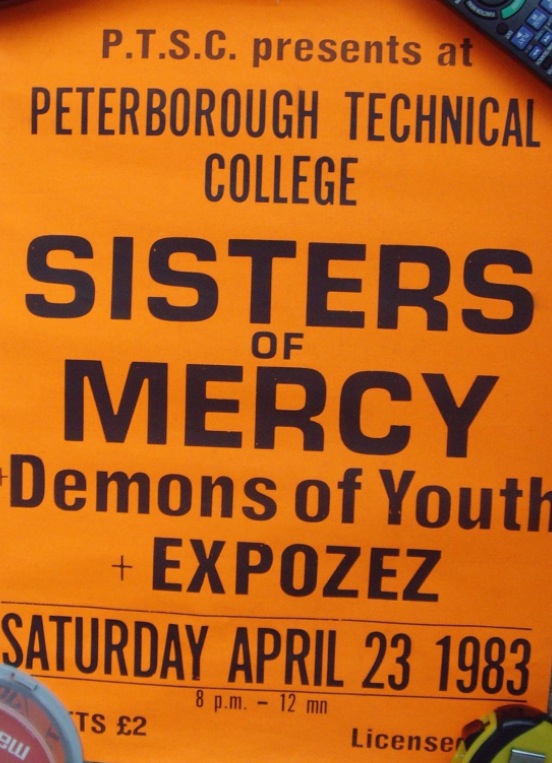
The date at Peterborough Technical College on Saturday 23rd April seemed at the time to be a bit of an anomaly, as TSOM had been contracted to tour with the Gun Club around the UK at that time, and the latter were due to play at Sheffield Dingwalls that night, with TSOM billed to appear as support on contemporary flyers. However, the band clearly had a prior commitment in the Fens, (indeed the closest gig the band has ever played to Eldritch’s birth town of Ely), and so Jeffrey Lee Pierce, Patricia Morrison et al took to the stage alone in Steel City that night, staving off the nightly fear of being upstaged by the Northern upstart support. The Sisters’ own appearance in Peterborough caused something of a stir in the provincial town, not a major stopping-off point for most indie bands who preferred to play in Leicester or Norwich (as TSOM themselves had done previously). Johnny M on Heartland Forum (in 2006) said “I lived opposite the College at the time and only popped across to the gig as I had nothing to do and was curious. 23 years later…”  The gig had a similarly profound effect on others, like Jack K who told me “There were very few gigs in Peterborough back then, just the Destructors, awful “Oi” stuff” (of whom more later). Another HL member, Loki, writing on the Forum some twenty years after the gig, said “I only found out about it a couple of days beforehand, seeing my local bus stop plastered with flyers for the gig and I thought “why not?” I went to the gig … and came away shell-shocked”.


What was it about this gig that meant that it had such an impact on those present ? The clues are (unwittingly) in the comments above, but for further evidence I am yet again hugely indebted to the very generous LG and Phil Verne for opening their incredible archives of TSOM memorabilia to produce the following poster and press cutting (respectively) for the gig, confirming some key details. Crucial for me is the list of support acts, “Demons of Youth” and “Expozez”. Google these two names and you will not find the relevant artists, as Huddersfield punks Xpozez’s name has been misspelt (hardly surprising as TSOM have lost their article, typically shoddy fact-checking by amateur promoters of that era) and Demons of Youth is a pseudonym for that afore-mentioned band of local heroes, the hardcore punk band The Destructors, whose fame had spread amongst the dying punk movement far beyond their native Cambridgeshire, a pseudonym based on the title of their most recent album to date at that time (“Exercise the demons of youth”).


Not only did TSOM have to follow the local legends in front of their loyal and baying punk audience, but they had to do so after an incendiary set from The Destructors,  which they were clearly so happy with that it later formed the basis of their Live LP “Armageddon in Action” - and all played through TSOM’s own backline. The Destructors teenage (a couple of years younger even than Ben Gunn!) prodigy guitarist, Graeme “Gizz” Butt (pictured second left), whose own innovative and influential playing style made an impression on later US grunge stars and lead to spells with The Prodigy and recently even Fields of The Nephilim (!), told Ian Glasper in the well-reviewed book “Burning Britain : the History of UK Punk 1980-1984” “The tracks were recorded at a gig where we supported The Sisters of Mercy. They let us use all of their gear which sounded great. The guitars are mega-loud and the drums are compressed all to hell, so the sound is really powerful.”

The same can be said of the TSOM performance in the echoey sports hall, fortunately captured for posterity by a lone video cameraman on the balcony, a shortened low-generation copy of which is available for all to see on YouTube. Johnny M (again posting on Heartland Forum) sums up the situation beautifully : “Taped from the balcony so lousy acoustics and sound distortion as the Girls were too loud for whichever tiny audio mic was trying to record them. Rough ’83 fodder, but just the way we like it”. This was also surely one of the gigs which Gary Marx was referring to the following year on the Radio Merseyside interview when he said “We’re not used to playing at such volume, and when we do, there’s an electricity that runs through us.”

But what of the gig itself ? The video recording starts with “Heartland”, but an audio recording (far superior in sound to the fuzzy video) which contains the full gig predictably start with the usual 1983 opening trio of “Kiss The Carpet”, “Alice” and “Anaconda”, making the set the usual 45 minute mark. The band seem to relish the challenge of winning over an audience more used to the likes of The Exploited and GBH, and it is clear from probably the liveliest TSOM moshpit ever that any prospect of them being blown off stage was immediately banished. Jack Kearney remembers that “not many people were there”, but those who were managed multiple stage invasions, as there appears to be no effective barrier between band and crowd, and if there were any bouncers provided by the local rugby club as suggested in this article on the venue, they had long since fled.

Everyone will have their own favourite song from the video footage of the show, despite its poor technical quality, and mine is definitely the start of “Floorshow” (the audio version of which has been very kindly uploaded to YouTube by Sisters collector Phil Verne for us all to enjoy), where Craig stops playing in his intro solo momentarily to “encourage” an over-enthusiastic punk stage invader to leave the stage, only for the latter to appear back on stage a few seconds later to ruffle both Gary’s and Ben's hair (the latter was admittedly a very tempting target, as can be seen in the photo below which was taken at the gig, arguably the best live shot of his time in the band). You wouldn’t get that level of disrespect down the Warehouse. Other 1983 footage (London, Glasgow, Amsterdam for example) is of far better technical quality, but the sound level is lower and the crowd too static to give the impression of the real excitement of a live 1983 Sisters show, something which the Peterborough film effortlessly renders.


“Heartland” and “Valentine” both showcase the slower, more powerfully melodic new material the band was working on at the time, but “Jolene” ushers in the first stage invasion as a dancer is ushered off stage by subtle use of Marx’s guitar. After an incendiary “Adrenochrome” and the full-throttle “Floorshow”, the punks seem to have had their fun and are less evident in the crowd shots from an ear-bleeding “Body Electric” (which closed the main set) onwards. The first encore of “Gimme Shelter” sees fans up on shoulders and finds Gary Marx struggling to pick out the melody, a state of affairs which continues in a somewhat shambolic wall-of-noise “Sister Ray”, which Eldritch’s ultra-echoey vocal somehow manages to bring back on track during the quieter passages. The song ends chaotically with Adams suddenly taking off his bass and leaving the stage, quickly followed by Marx (who had been lying on his back at that stage) and Gunn, leaving Eldritch to bring things to a close a capella, as he had on the previous song.

Remarkably for those who have seen the full footage of the gig (and not the abridged YouTube version), the cameraman left his camera running for six minutes after the end of Sister Ray, enabling us (except for viewers in Germany, thanks to copyright issues with the post gig music) to uniquely watch the band casually inter-acting with each other and with their followers after the show (again thanks to Phil Verne's generosity in uploading this). The post-gig tape music (an obscure king Sunny Ade track, fact fans) is even initially interrupted by an enthusiastic Ben Gunn, who encourages over the mic those remaining to come to see the band supporting the Gun Club the following evening in the Lyceum in London. After a panning shot across the college’s main hall (allowing us to see the sixty or so fans who remained), we see Claire who appears from the moshpit carrying a large boogie-box and puts it down on the edge of the stage, and then chats with Andrew who is kneeling at the front of the stage. The latter, scarf still dangling from his belt then goes down into the pit and chats with Craig and Ben who have also left the rest of the stage tidying task to the roadies. Gary can also be seen walking past, his shoe held together by tape. This mingling with fans before and after shows was a regular occurrence at shows of this era, and Jack K remembers a roadie asking him if the band could sleep at his place that night, and to his eternal regret, he declined !


The band also found time to sign a few copies of the Alice/Floorshow 7” single for the local indie record shop, rare copies indeed with all four signatures, one of which was bought by a Jayne P and later sold on to Phil Verne, who reveals that Ben (clearly unused to signing autographs) had also initially signed it on the back ! Perhaps unsurprisingly, not many other bands seem to have played the Technical College after TSOM, and it changed its name to Peterborough Regional College in 1987, and in 2009 the College opened a new satellite campus of Anglia Ruskin University called University Centre Peterborough. 

The Sisters never returned to Peterborough, but their performance there made a lasting impression not only to the lucky few locals who attended and were turned into long-term obsessive fans, but also those of us who have come to enjoy the band at their wildest and most potent, loud and punky, Eldritch snaked around the mic like a cross between Jim Morrison and Joey Ramone, Marx careering out of control across the stage battering the hell out of his guitar whilst somehow (occasionally) picking out familiar riffs, Gunn providing an extra dimension to fill out the sound, whilst Adams prowls the stage as the enforcer at the same time as laying down the scuzziest of bass riffs since the first Motorhead album. If they have ever bettered the second half of that gig – Jolene /Adrenochrome / Floorshow /Body Electric /Gimme Shelter/ Sister Ray – I would love to hear it. If anyone is still in any doubt, in one interview Andrew Eldritch himself acknowledged this period as the band’s live zenith, nominating the London show with the Gun Club the next day as the best the Sisters ever played. 

As ever, I would like to acknowledge the huge amount of assistance given to me in compiling this post, particularly by inveterate colllectors Phil Verne and LG who have once again generously shared items from their treasured collections. If you have any old Sisters memorabilia gathering dust, they would love to hear from you! Thanks to to Jack K and others who were lucky enough to be at the show and have shared what they can remember from what was a very special evening.


Sunday, 31 January 2016

Crash and Brum 3

(This blog post is the final one of a trilogy about the gigs played by TSOM for Nitelife Promotions in Birmingham and should be read in conjunction with the previous two).

Barely two months after the triumphant gig at the Fighting Cocks in suburban Moseley, TSOM were back in Birmingham once more on their March '83 mini tour, playing this time at the best known of the pub venues, the legendary Golden Eagle in Hill St in the city centre.


For a long time there was a lot of doubt as to whether this gig took place at all. On Heartland Forum a decade ago, Dave R was adamant that it didn't happen. "The Birmingham date was the Selly Park Taven with the Wild and The Wandering (who became PWEI and the Stuffies) as support. I know because I was there. The only Golden Eagle affair was when Motörhead played the Demolition Party and a few Sisters were in their entourage." (in the first part of his statement he is clearly referring to the Bournbrook and to From Eden who became The Wild and The Wandering)

However, on other online Forums, others began to appear who had allegedly been at the gig, usually as part of a "Who did you see before they were famous?" thread, whilst a Songkick user stated that a band called Step Forward had been the support, an unusual detail for a "phantom" gig.


Within a month of each other two long-term fans furnished me with a photo of the poster for the gig, first the ever-generous uber-collector LG, whose copy is pictured above, and then, even more incredibly a lady called Paula also got in touch, as it was her first TSOM gig and she too had a copy of the same poster. Sadly, however, although she remembers having been to the gig, she understandably couldn't recall any specific details alongside the many other gigs which she attended in that era. Surprisingly, given the extent to which TSOM gigs were being bootlegged as they began to dominate the indie charts, no recording or photos have survived from the gig, which was the night after the Liverpool and the night before the Colne gigs previously covered in this blog. As can be seen from the rather informal poster ("two quid in"), the promoters (Nitelife) were the same local enthusiasts who had put on the previous two gigs, this time elevating the band to the biggest venue on their circuit, and which had a reputation (somewhat unusually given its city centre location) of being a bikers' pub at the time of the TSOM visit.


The Golden Eagle stood on the site of an earlier pub, and was the pride and joy of brewers Holts when it opened in 1936, redesigned by the architect FJ Osborne. With its polished black granite facade, and metallic golden eagle motif by noted local artist William Bloye just above what was originally the main entrance, the venue should have been a listed building in its own right, not to mention its incredible musical heritage stretching back to the 1960's. More recently to the TSOM gig, bands such as Iron Maiden and U2 had stopped off there on early tours, playing the upper floor music room which was only accessible via a steep and winding staircase, on which local band 021 are posing in this contemporary photo from the Birmingham Music Archive website. A member of the Birmingham History website (going by the name of "The Purple Cow") remembers the venue well. "It was a lovely, warm, atmospheric place with extraordinary Art Deco internal architecture, fixtures and fittings. The journey to the men's loo was particularly extraordinary, being a long subterranean journey along an originally tiled corridor with authentic period light fittings and brass handrails"


Generations of bands had lugged their instruments and amps up and down these stairs, but eight months after the TSOM gig the pub closed its doors for the pastime, condemned because of structural faults which would have been difficult and expensive to fix for a pub with a dwindling clientele, the post office having by now vacated the neighbouring building. Apparently, not even the famed brass golden eagle plaque survived the demolition, which was unsuccessfully fought by a pressure group determined to keep one of the finest examples of Art Deco architecture in the West Midlands.


Like so many other demolished former gig venues, the site of the Golden Eagle is now a car park, with no sign of its former glory. TSOM's next visit to Birmingham would be of a much higher profile, the legendary first gig with Wayne Hussey at the Tin Can/Fantasy club just over a year later ...

(My thanks are due once again to those who have provided memories, photos and souvenirs of this gig, particularly Paula and LG on this occasion).