Thursday, 24 January 2019

Second and Last and Always Pt 2

(This is the second of three posts on what the second album by The Sisters of Mercy might have sounded like in 1986, had the First and Last and Always line-up continued to record)

Of the three elements into which The Sisters of Mercy fractured in 1985, the pairing of Wayne Hussey and Craig Adams were the first to show publicly how the second TSOM album may have sounded had the band stayed together. Despite the long-term disputes within the band, followed by Marx’s departure in April, and the increasingly frosty atmosphere between Eldritch on the one hand and Hussey/Adams on the other, it appears that all three remaining members were still prepared to give a second TSOM album a go, and history records that they gathered together initially in Hamburg in the late summer of 1985 to work on demos. Hussey later told Sounds magazine (January 1986) “As far as Craig and I were concerned, we’d resigned ourselves..we’d not been enjoying it for a while, but we’d resigned ourselves to sticking it out, and maybe it would’ve got better. But in fact it was getting worse. I went to Hamburg for a month with Andrew to try and write songs for the second Sisters album, and we came back with all my ideas rejected and Andrew’s very skeletal…Andrew said, “I’m not singing any of your songs. That’s what it boiled down to. Craig walked out of rehearsal [having famously refused to play the bassline for the song which became “Torch”] and a day later I did.” The following year he would tell Germany’s Spex magazine, “Andrew rejected all my songs and let me work on one single chord the whole time – E minor!”

On Hussey and Adams’ return to the UK, they immediately went into a new 24 track studio which had opened in Yorkshire, Slaughterhouse Studios in Driffield, a sleepy market town between Hull and York. It was both cheaper and nearer than Stockport’s Strawberry Studios, and given that Ghost Dance and Eldritch also recorded (separately) at the Driffield studios in the latter months of 1985, it is clear that this was the venue where the band had planned to record the follow-up to FALAA during late autumn (Sounds in November 1985 reporting that the departure of Hussey and Adams “has scuppered recording plans for a new album this month”). Presumably WEA had booked the studio time in advance, and therefore by design rather than coincidentally all three shards of the early 1985 incarnation of The Sisters of Mercy independently recorded their first post-split demos there before the year was out!

(Slaughterhouse Studios)

With what at the time seemed almost indecent haste to some, although more understandably given that Hussey had a whole host of almost finished songs ready to go, the band that would become The Mission were first through the recently-opened Slaughterhouse doors. At this stage (October 1985), the group had no permanent drummer as Mick Brown had yet to officially join from Red Lorry Yellow Lorry, doing so formally after one final RLYL gig on 29th November 1985, but he played drums on the Slaughterhouse sessions. These sessions would yield the songs Wake and Naked and Savage, both of which feature in their original form on the B-side of the debut Mission release in May 1986 on the independent Birmingham-based Chapter 22 label, along with A-side track Serpent’s Kiss, which as we discussed in a previous post, he had already recorded as an instrumental in preparation for Eldritch’s added lyric and vocal on Easter Monday 1985, immediately after Gary Marx’s departure, with a view to it being the next Sisters “A” side. The October 1985 version (this date features prominently on the back of the record sleeve of the first Mission single) of course features Hussey’s own lyric and vocal, and rather than the next TSOM single as originally intended, it became the lead track to launch the new band, picking up the airplay which would see the vinyl release rocket up the indie charts the following spring. 


Wake (RSV) in particular attracted attention because of its lyrical content, which has been interpreted as a (very) thinly veiled attack on both Eldritch's inactivity and his increasing isolation ("Pillar of wisdom and soul of iron, Alone in the crumbling tower of power" etc). The fact that the title is the same as the name Eldritch had given to the Royal Albert Hall gig, that there was an RSV (Revised Standard Version) of the Sisterhood's debut single and these three letters did not appear on the demo tape version of Hussey's song, and the run-off groove of the A side stated "Keeping the Faith, not Giving Ground", another seemingly direct reference to Eldritch's rushed post-split single, only served to confirm these suspicions. Presumably Hussey penned these waspish lyrics in the studio and sang them over a melody originally intended to have Eldritch's words on top - "It's a taste of your own medicine. God's Own Medicine for you!" Hussey was obviously particularly pleased with the latter lyric fragment, using it as the title for the Mission's debut LP, even though Wake (RSV) wasn't selected for the album! Conspiracy theorists with a detailed knowledge of the events of this era will also spot the words "victim" and "circumstance" in close proximity to each other in the lyric, plus a reference to "revenge", all of which presumably did not escape Eldritch's notice either.


Also recorded at that initial Slaughterhouse session was another song presumably intended for The Sisters, Bridges Burning (a different version of which would be on the debut LP God’s Own Medicine) and the original Slaughterhouse demo (Burning Bridges) finally saw an official release in 2007 on the extended reissue of the band’s The First Chapter compilation album. Wayne Hussey makes it clear in his sleeve notes for that release that ex-Artery guitarist Simon Hinkler had not yet joined the band for the Slaughterhouse session, although he does feature on the sleeve for that first Mission EP, having joined the group in late December 1985 (Hussey told Sounds “We only got Simon three weeks before this tour” when The Sisterhood’s live dates began) between the recording of the first single and its eventual release once the Sisters/Sisterhood name wrangle (a very well-known tale) was resolved. The lack of a second guitarist for these first recordings, and the presence of a stand-in (at that time) drummer, are furtehr evidence of the good faith of Hussey and Adams in attending the initial writing sessions with Eldritch, as they clearly had no fully realised Plan B at that stage.


A fifth song which Hussey had originally intended for the Sisters was of course Garden of Delight, which would ultimately become the Mission’s second single and their final release for Chapter 22 before they signed to the major Mercury label. An earlier version of Garden of Delight featuring Eldritch singing Hussey’s lyric had been recorded at Strawberry Studios earlier in 1985 following the recording of FALAA (and not during the FALAA recording sessions in 1984 as is often claimed), and is one of the best-known TSOM bootlegs. Of all the existing material, this track gives the biggest (and indeed only definitive) clue as to how “Second and Last and Always” might have sounded had Eldritch been in a more democratic mood and accepted Hussey’s songs (including lyrics) without question. Incidentally, Eldritch himself referred to his Garden of Delight vocal directly in a Swedish TV interview in the early 90’s, saying “There are a few bootlegs in existence of me trying to sing Wayne’s words, and you can hear that I’m not convinced by them. I can’t breathe any meaning into them!”

(Mass Murder fanzine interview)


Eldritch was not the only one unconvinced, with WEA rejecting the initial Slaughterhouse demo recordings because Hussey’s vocal was not deemed to be strong enough. Hussey had hoped that the single would be released as early as January 1986 on WEA according to an interview conducted in early November 1985 for Mass Murder fanzine, but “we’ll know at the end of the week, they haven’t heard the tape yet.” In the same interview, Wayne states that “There’s a 12” which will have two tracks on each side,” which explains why there was a finished Bridges Burning in the vaults, as the ultimate Chapter 22 release only featured the one track (Serpent’s Kiss) on the A-side. He also states that the band will be called “The Sisters, just The Sisters, me and Craig. It’s going to be really good, it’s going to be brilliant” he adds, in the style of a certain modern self-praising president!


Speaking to Mark Musolf for a YouTube interview a couple of years ago, Hussey explained the process by which he ended up fronting the project, light-heartedly acknowledging that his vocals were at least initially not the best : “At that point [having split from Eldritch in September 1985] we wanted to get someone else to sing…We auditioned a couple of people, it didn’t work ,it didn’t feel right and Warner Brothers suggested a couple of people, and we said “Really? You’re not really getting this are you?” So Craig and I went to see Simon Denbigh and he said “You do it. [jokingly adds] You’re better looking than him.” I looked at Craig and [said] “Shall I?” and [he said] “Yeah go on. Don’t worry about the words, you can string together any old rubbish, it’ll be fine. It’s only journalists and other singers that worry about the words.” And I said “Ok, I’ll have a go.”  I came into it by default and it took me a while to warm to the role.” Within a couple of years, Hussey would be winning “Best Singer” accolades in readers’ polls in music magazines, so it was little surprise that when I posted a link to the video of the Musolf interview on the TSOM 1980-1985 Facebook Fan page, highlighting March Violets’ singer Simon Denbigh’s part in Hussey becoming the frontman, the former commented “Je ne regrette rien!”.  

There will have been many other ideas which the Hussey/Adams combination had in mind for The Sisters’ FALAA follow-up, and one of these surfaced as recently as 2017 on The Complete Another Fall From Grace, the deluxe repackaged (fan-fleecing!) version of the recent Mission album which Hussey had trailed as a return to the mid-80’s sound of The Sisters, even suggesting that it was “the missing link” between FALAA and God’s Own Medicine. The bonus track Sleeping Pills was in fact a new vocal and guitar over-recording of a demo made for the Sisters in 1984/5, and a most intriguing track it is too. Featuring a much slower and more languid melody, with psychedelic tinges, it has more in common with, say, Body and Soul than with the Hussey-penned tracks on FALAA. The track starts with a Dr Avalanche-style drumbeat followed by a repeated minor scale guitar riff which is typical of that period. When Sleeping Pills first emerged, to a disappointingly muted reception it has to be said given its historical significance, I likened it to one of the tracks on (Salvation’s MR album) Clash of Dreams, or a low-fi Poison Door, as it had a B-side feel to it, ironically not unlike Giving Ground in fact. Hussey played the song several times live, and videos of these performances have been shared on the web (including on the Mission Fan Club Fan Page) for those who want to hear it in its refashioned form.

Phil Verne, the main administrator of the TSOM 1980-1985 fan site and a TSOM obsessive who also keenly followed the Hussey/Adams-led new ensemble, has also shared (originally from the same tape as the Some Kind of Stranger instrumental version) this incredible rare version of the epic Wasteland, which would go on to become The Mission’s breakthrough hit (and fourth single overall) when it reached the UK Top 20, far outperforming any of the TSOM releases up to that date. The multi-layered instrumental demo version which Phil shared was recorded by Wayne alone in 1985, and therefore the tune presumably featured amongst those song ideas offered to Eldritch. What is particularly interesting is that it features a drum machine, meaning that it not only pre-dates Hussey’s work with Mick Brown, but that it was clearly intended for The Sisters. There is informed speculation that this was just one of many songs which Hussey had worked up into almost complete demo versions for (what we are calling for the purpose of these blog articles) “Second And Last And Always”, but this version of Wasteland is the only song to have been shared. This version of the Mission’s breakthrough hit is therefore very likely to be the very one which Eldritch rejected! God’s Own Medicine indeed! 

Hopefully Hussey’s much-anticipated forthcoming autobiography will shed substantial and definitive further light on the precise chain of events of autumn 1985 and what his (and largely silent partner Craig Adams’) contribution to the potential second Sisters album might have been. However, as we have seen, the contents of The First Chapter and God's Own Medicine clearly give a very precise indication of how the musical backing and structrues, if not the vocals and lyrics, of the songs of "Second And Last And Always" would have sounded after Gary's departure, had Eldritch's FALAA writer's block continued and the susequent split not occured. 

The final of this trilogy of blog posts about the likely sound of a follow-up to FALAA by the 84/85 line-up will focus on the relatively recent major revelations about Eldritch’s own plans for this sadly mythical release –  which he gave the working title “Left On Mission And Revenge”.

My thanks for this post are due to collector LG, DJ Mark Musolf, legendary Sisters fans Lee EMWK, Nigel W, Kutna H, and Phil Verne of the 1980-1985 TSOM Facebook fan group, and to ever-affable Mr Hussey himself who has patiently confirmed some of the above details to various fans over the years.


Fans of early-era TSOM who have not yet done so should seriously consider subscribing to Mark Andrews' forthcoming history of TSOM.



Tuesday, 8 January 2019

Second and Last and Always – Part 1


(In a series of four previous posts, we examined the events that resulted the definitive splits in the band in 1985, shortly after the release of debut album First and Last and Always. In this and two subsequent posts, we are going to look at how the band’s follow-up might have sounded, if the “classic” line-up had managed to stay together, beginning from the perspective of the first member to leave that year, Gary Marx).
“I’d like to see the second album go to number one in the LP charts…Second and Last and Always…we’ve got the title already!” – Gary Marx, Artificial Life fanzine interview, March 1985. Although founder member Marx was clearly joking about the LP’s title, it was obvious that for a long time he still planned to stay in the band before his decision to leave the band after the Old Grey Whistle Test recording on April 2nd 1985.

Had he stayed, and had the format adopted on FALAA remained the same (i.e. a side of largely Hussey compositions, followed by a side of tunes primarily penned by Marx), then we can have some idea of how the songs may have sounded, thanks to the very detailed notes which Marx produced for a Recording Diary for the sadly now defunct Ghost Dance website, for followers of the band which he formed with Ann-Marie Hurst, former vocalist with Bradford band Skeletal Family who had been the support act on TSOM’s legendary Black October tour the previous Autumn.

In these detailed accounts, Marx explains that a number of Ghost Dance tracks had their genesis in riffs which he had originally created for use with The Sisters, and although Eldritch’s lyrics and melody would clearly have been different to the finished GD versions, these nonetheless give an insight into the direction in which Marx would have wanted to take the band.


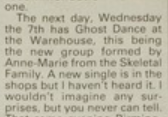
(Leeds Student preview April 1986, written by Gordon Taylor)

Yesterday Again (recently played live again by the now-reformed Skeletals) is one such song which had a noble lineage, as Gary explained: "The Sisters minus Eldritch had actually recorded a version of the song which became Yesterday Again in Strawberry [Studios}. It was originally titled Frail and Torn and Wayne sang my half-finished lyric one afternoon along with the first draft of The Mission’s Garden Of Delight. We used to refer to Frail and Torn jokingly as a potential Christmas single for the Sisters." This would indeed have been a welcome alternative to 1985’s actual Christmas number one hit, Merry Christmas, Everyone by Shakin’ Stevens. Sadly, no version of Frail and Torn has yet surfaced amongst collectors, so we will just have to take Gary’s word for its commercial potential, which does not seem over-fanciful given the typically epic spaghetti western guitar riff underpinning the song.


Another relic from the Strawberry Studios sessions for FALAA was Ghost Dance’s debut single in 1986, River Of No Return, of which Marx wrote : “The songs and the recording came about fairly quickly and Anne Marie and Etch pretty much stepped into ideas I carried over from the Sisters. The lineage is fairly evident in the songs and the packaging. I had the ideas for the original songs mostly in place by the Summer of 85 - I came up with the riff which features in the middle section of River… sitting in the reception area in Strawberry Studios during the first phase of recording for First And Last And Always. At the time I thought it would form the main part of a new track, but I played around with some variations and came up with the bass line which is the real focus for the verses in RiverThe chorus guitar line is pure Sisters (‘ ..all on one string and job’s a good un’ as Choque from Salvation was keen to point out). The way the riff steps up a string halfway through the verse was also something we did on the early Sisters stuff - Floorshow, Alice, Good Things…kind of a nod to bands like the Cramps who we all loved. The artwork followed the formula the Sisters had used to some extent with the famed Lady Of Shallot unceremoniously nicked and planted on the front cover. The back featured the wings logo I’d drawn based on a picture I’d seen in a book about American architecture (the full photograph formed the cover for Gathering Dust).”


(Live review by "Papi" in Leeds Student, May 1986)


A third idea originally sketched for the Sisters which Gary may have developed for the FALAA follow-up had he remained in the band surfaced in a further Ghost Dance song, Cruel Light, and the recording notes (written in the early part of this millennium) shed further light on one of the more curious episodes of 1984/5. “"[Ghost Dance producer] Steve Allen ... originally had a tiny studio in a rehearsal complex off Armley Road where I’d been with Wayne to record some new demos with him singing. We attempted the track which became Cruel Light but never finished it....The lines ‘I see them cut and die, see the flowers bleed..’ from Cruel Light was actually first used as part of a draft of another Sisters’ song I’d written called Temple Of Love (not the song we now know and love by that name)." You certainly don't need to be a musicologist to spot this as a Sisters-style riff. Whilst Eldritch may have suffered (and still does) from writer's block, Marx's creative juices were certainly flowing strongly (albeit with variations on a similar theme) in the mid-1980s. Eldritch mentions in a later interview (in Q magazine in 1988) how the other members of the band had had a go at singing at a time in 84/85 when he was thinking of withdrawing from the role to become the band's svengali manager (“and so discreetly, abroad, everybody had a go at singing, and decided that they weren’t very good”) and the original Cruel Light demo with Wayne singing may well be the kind of experiment he was referring to, albeit much closer to home.

A fourth Ghost Dance song which in a different guise might have featured on Second And Last And Always is A Deeper Blue, one of the strongest melodies in the Ghost Dance canon. It obviously made a similarly positive impression on Wayne Hussey, who borrowed the chorus melody (with song title repeated) note-for-note on The Mission’s UK Top 40 hit Beyond The Pale a couple of years later. The intro has shades of FALAA’s title track, but Gary’s comments in his Recording Diaries reveal that a different song of that era was the main source : “A Deeper Blue was one of the last of the ‘carry-overs’ from the Sisters. I had written a lyric to the tune which became Nine While Nine which started with the lines ‘the colours fade somewhere inside…’ I had the tune in my head long after and just finished it without a guitar while walking in Wakefield – it all happened very quickly, I was imagining the guitar hooks and coming up with the words at the same time. I always think of it as a Wakefield song. I went back to the guitar and figured out the riffs I’d been whistling and found they worked with roughly the same chords as Nine While Nine.” Intriguingly, a later post (by Marx) on the Ghost Dance Forum revealed that A Deeper Blue has more in common with an early demo for Nine While Nine with a different working title which has yet to surface: “I have often wondered how the Marianne (Red Skies Disappear) song leaked out on bootleg, and naturally assumed that if it was doing the rounds, then the Nine While Nine version recorded at the same time was out there too. It has the working title Child of Light and contained a line which mentions “the children of the dust.” When we were deciding on a title for FALAA I pitched that one in, even though it didn’t seem likely that the [i.e. Marx’s own] lyric would surface on the finished version. Quite reasonably, Von then pointed out that we were over-egging the “something of something” being called The Sisters of Mercy after all.”

The final Ghost Dance song with a TSOM link is probably the one which would have been most likely to gain Eldritch’s approval back in 1985, given that he was listening to a lot of soft rock in the Stevie Nicks vein, and is evidence that the original duo’s musical tastes were not that far apart. When the song When I Call finally came out in 1987 on the A Word to the Wise EP, Ghost Dance were still on indie label Karbon, but had they saved this song for a few months until they had the commercial might of Chrysalis behind them, they might have achieved the chart success which The Mission, All About Eve and The Sisters were by then achieving, a source of considerable frustration to the band. In his Recording Diaries, Marx states that When I Call was one of three tracks on the EP that "were among the first I’d written and date back to that period in ’85 when it wasn’t clear if I was going to carry on in the Sisters or go my own way....When I Call was there from day one of Ghost Dance – we played it in the first gig when we were still a three-piece, we demoed it in the Slaughterhouse in late ’85, and although it assumed epic proportions in the final recording, the core ingredients were much the same. Again there are fragments of lyric which had surfaced on Sisters demos – the original version of the song FALAA [Marianne (Red Skies Disappear)] had contained the line ‘only you can say the words I need to hear’ which forms part of the chorus to When I Call...The version of When I Call [on the EP] included multiple guitar tracks, Hammond organ and guest vocals from Daniel Mass of Salvation. Richard and John both proved to have decent voices so they feature on backing vocals as well. The producer allowed Anne Marie to sing in the control room without headphones, something she’d been keen to try for a while and he got some good performances out of her."

Poignantly, there is one further Ghost Dance song with a clear link to The Sisters of Mercy, but not musically. Gary Marx's birthday thirty three years ago might have been a personal celebration with friends rather than the expected final appearance at the RAH with the Sisters, but at least we got another great song out of it. As he later explained : "Celebrate was sort of written in my head on my birthday while out in the Black Swan in Wakefield. My birthday was the same day as the Sisters’ Royal Albert Hall Show, recorded for posterity on the Wake video. I was going to play the gig and then didn’t (far too hideous a tale to go into here). I knew by then it was going to mark the end of the Sisters as a real band and knew a good many of the crew and the following who would be at the gig and the emotion surrounding the evening – Celebrate was sort of a song for and about the event I wasn’t taking part in. I viewed it fairly positively – it wasn’t meant to be a rant by the injured party or anything. Lines like ‘and on this hallowed ground..’ were really about the reverence the venue and the occasion seemed to invite and a sort of mental picture I had of the human pyramids, arms aloft and the smoke reaching up into the dome. I probably wrote the first verse separately at a later date after I’d sobered up!" 

Imagine if Gary had had a change of heart and had rejoined the Sisters after the Albert Hall gig, and the band had kept the same songwriting split as for the first album: what better way to close the second Sisters’ album than with a song about their greatest live show?

My thanks for this post are due of course to Mr Gary Marx for his wonderful recollections on the old Ghost Dance website, and to the many fans (Don, Martin, etc) who are always keen to ensure that Marx's key role in the band is fully acknowledged. This one's for you! The next post will look at the Hussey/Adams pairing and what their contribution to "Second And Last And Always" might have been.

Monday, 29 October 2018

First West Coast US gig - L.A., 29th October 1983


Today sees the thirty-fifth anniversary of The Sisters of Mercy’s first-ever gig on the West Coast of the USA, one of three concerts the band played as a three-piece following the departure of Ben Gunn after the East Coast shows the previous month. Just three days after the Stockholm show, the remaining jet-lagged Sisters arrived in California with just their instruments for equipment, as Craig Adams told The Quietus for this excellent feature by Mark Andrews: “We didn’t even have guitar cases. You had a guitar in a plastic bag with your cable, fuzzbox and your other cable. That’s how we landed in L.A.”


Adams’ fuzzbox was of course one of the key elements in The Sisters’ sound, and one which would take an even greater role in these three gigs where they were just down to the one guitarist. As Gary Marx drily observed to Mark Andrews in the same Quietus article, “The idea to carry on and do the few shows we’d got booked in the autumn may have been partly to do with whatever relationship was going on between Andrew and Patricia Morrison.” Eldritch and the Gun Club bassist had become close friends when the two bands had toured the UK in April that year, and this may well have been a contributing factor in the very well-informed preview that appeared in the prestigious L.A. Times the week before the gig, which stated that The Sisters’ use of drum machine, throbbing bass and fuzztone guitar re-energised “the often dreary gloom of Britain’s post-punk sound with a revitalizing charge. With his deep low voice, Eldritch summons a psychodrama theatricality in the best Jim Morrison tradition. The Sisters’ set ranges from kinetic, melodic melodrama to dreamy, eerie textures.”

The author of this purple prose was none other than Craig Lee, a former bandmate of Patricia Morrison in seminal L.A. punk band The Bags, who was then playing his trade as a writer best known as the editor of Flipside magazine, as well as his regular contributions to the L.A. Times and L.A Weekly. Lee, who sadly passed away in 1991, wrote an equally positive review of the gig itself, published two days after the show, ending with the comment: “The recent loss of a second guitarist has left the band sounding a little thin. However, with strong originals like “Temple of Love” and an inspired reworking of Velvet Underground’s “Sister Ray”, The Sisters exhibit a vibrant rock’n’roll heart.” Marx too felt that the slimmed-down line-up still worked well. He told The Quietus, “The shows were actually great with the three of us. I knew I was going to be more exposed as a guitarist but by then it wasn’t quite the problem it would have been in ‘82”.


(items from the collection of Bruno B and LG respectively)

Apart from Craig Lee’s enthusiastic pre-publicity, another factor for the gig’s popularity would have been due to the promoter Gary Tovar'sGoldenvoice, who produced a plethora of flyers and posters for the show, many of which have survived and are now in the hands of well-known TSOM collectors. Goldenvoice went on to become major players in the gig promotion world, as Wikipedia will testify, but back in 1983 they had only been around for two years and were an enthusiastic team desperate to give punk bands the opportunity to play. Nowadays, they are AEG’s “cool” subsidiary which promotes the world-renowned Coachella Festival.

The Sisters’ LA gig featured no less than three support bands, all interesting in their own right. Legion, playing their first gig, featured future members of better-known bands whilst Cathedral of Tears was the new post-punk/new-wave outfit of legendary punk vocalist Jack Grisham, former leader of the band T.S.O.L, which had broken up earlier that year. The final act listed is the most intriguing, Unit Three featuring Venus. This was an incredible act, a kind of punk Partridge Family making music in the style of the B52’s, featuring Mom Patty Bondage on bass, Dad Henree Herd on keyboard and their pre-teen daughter Venus DeBaun on vocals. The latter had been only eight when singing B.O.Y.S.on the 1981 compilation Rodney on the Roq, which also featured the likes of Black Flag, Social Distortion, Minutemen and Redd Kross. The band is probably best remembered for “(I don’t like) Beer”, the single of the following year. Thanks to the wonders of social media, I managed to track down Venus, who went on to have a career as a PE teacher. Understandably, given that she was only ten at the time, she sadly had no recollections of the show.


(Pics - an early postcard view of the original lobby, and a fan photo courtesy of Paula H)

Craig Lee’s contemporary review of the gig makes reference to the “less-than-exclusive downtown” surroundings, and Craig Adams’ memories of the show, quoted in the Quietus piece concur : “It was a no-go area”. This might come as a surprise to those who have seen photos of a bearded Eldritch at the show, performing under an incredibly ornate ceiling. The Hotel Alexandria had been the jewel in L.A.’s crown when it had opened in 1906, playing host to Presidents and Hollywood stars alike, drawn to the Egyptian-themed opulence of its public areas. As can be seen from the above postcard, the roof under which Eldritch performed was originally above a two-storey lobby, but an extra floor had been inserted in a 1930’s re-design, leaving an incongruously low mixture of lighting fixtures and pipes, and has over the years, the "Green Ballroom" has become a favourite of film-makers and rock video crews (as in these famous examples featuring Lenny Kravitz and Adam Lambert). The Alexandria continued to operate as a hotel until earlier this decade, and the room where the Sisters’ played can be seen (renamed the “Mezz”) on this video footage of a tour of the hotel by a well-known chef, Ilan Hall (4 minutes 20 in). Since the 2015 redevelopment, with the upper floors turned into condos, the Mezz is now one of the Alexandria ballrooms, an events space currently booking for 2020.

Back in 1983, however, the downtown area was, like the hotel itself, decaying rapidly, much like the infamous Tropicana Motel where Marx and Adams were marooned whilst Eldritch hung out with Morrison’s gang, as the guitarist told The Quietus. Adams’ memories of the show itself were that “the promoter had put out folding seats - well that didn’t last long!”

The gig was recorded and the bootleg tape is well-known to Sisters fans, containing a full record of the set, which opens with a reverb-drenched Burn, with Eldritch’s echoey vocal, which misses a few notes towards the end of the song, very much to the fore. The overall sound is impressively full and the song is well-received, despite the singer’s concerns about the lighting level: “Sorry about all these house lights, nothing to do with us.” Before launching into a perfect rendition of Valentine, he gives the audience his first impressions of L.A.: “People in Los Angeles have no legs – too many cars”. After the relatively slow start of a pair of songs from The Reptile House EP, the pace picks up immediately with a speedy version of Anaconda, with Eldritch’s vocal again very echoey, much like on the psychedelic demo version of the song a year earlier. Disaster struck in the middle section of the song, with Craig Adams breaking a string on his bass, leaving just Gary and the Doktor to carry the instrumental section of the song. Eldritch returns for the final vocal section, the first time the two (Marx and Eldritch) had been heard as a duo since the release of the debut single! There then follows one of the lengthiest pauses ever in a Sisters’ set, presumably whilst a new string is located and then fitted to Adams’ bass (we can all relive this episode thanks to Phil Verne of the 1980-1985 The Sisters of Mercy Facebook fan group who has uploaded the extract to YouTube). Eldritch complains about the mix: “I can’t hear myself”, before unwisely taunting those members of the crowd who are still seated – “You know you can get bed sores if you stay there too long.” To pass the time, Gary plays an extended solo version of Ghost Riders in the Sky, before Von shared the band’s latest news: “Next time we come there’ll be four people because we’ve got a new guitar player.” However, the crowd are clearly growing impatient, and bored punters begin to throw the chairs at the band. “Anybody got any more furniture ? I just stand here like a lemon,” quips the singer, clearly not fazed. Marx begins playing Yankee Doodle in a forlorn attempt to pacify the crowd, whilst Eldritch again tries humour to try to defuse the situation: “I’m perfectly happy with the number of teeth I’ve got, thanks. One less would not be very good for me. So that’s the last chair I’m going to accept up here. If you could just pass them the other way from now on….” Finally, Adams' bass is fixed, so the gig can resume, but sadly things get even worse. Flagship new single Temple of Love starts disastrously, with Eldritch missing his entry cue, and singing the opening line completely out of sync with Marx’s guitar. “We’re going to try again when this frank exchange of views has finished. We’re going to be very reasonable about this.... We’re blowing this amplifier up…We haven’t got another one you see...Maybe we should tell you some leper jokes, like we did in Boston. Are there any lepers in the house?” Not a “joke” which he would attempt in 2018, I suspect. After making their way – just – through Temple of Love, Eldritch jokes: “Sounded better like that, doesn’t it?”, before again complaining “I can’t hear myself up here. I can’t hear myself at all,” which evokes more jeering from the crowd, who even after an excellent Heartland are still very lively, as L.A. punk audiences were apparently wont to be. “So this is what sunshine does to you, huh? I think that I can live without it” is the singer’s cutting verdict, before announcing the “tear jerker” Emma, with its buzzing bass intro, and Gary using a flange effect on his guitar during the chorus to flesh out the sound, of the song, which nevertheless becomes a little loose towards the end.

With the next three songs the band finally win the crowd over, a punky Adrenochrome with a spectacularly good Eldritch vocal followed by Floorshow, with its usual powerful intro, but whose sound overall is noticeably thinner, suffering more than most from Gunn’s departure, and then a bass-driven canter through Body Electric . Eldritch engages in more banter with the audience who have requested songs which the band no longer play live “No we don’t play Jolene anymore.” Instead, the crowd are treated to Gimme Shelter, which works surprisingly well, with Marx skilfully switching between the two guitar parts, and it ends with a very lengthy Von/Craig drum machine-free coda. With the band having left the stage, there are enthusiastic cheers for an encore from an individual near taper, which are duly rewarded as the band return. “I’m Taurus” the singer replies to an unheard question, before the band launch into Alice, with the buzzing bass sound again dominant and the second guitar barely missed. Finally, Sister Ray brings what in many ways was a memorable show to an end, as wild as ever, and although the middle section is a little truncated and thin-sounding, Eldritch is at his Vega-esque best as he whoops and screams through the finale.

The Sisters would not return to LA until the late spring of 1985, when again they would be down to just the three human members, having not made it as far as the West Coast on their two 1984 visits to the States, although the California area had clearly influenced Eldritch's lyrics on Black Planet.

As ever, this post is very much team effort, with many fans having contributed to build up a picture of the events of October 1983 - especial thanks go to LG, Bruno B, Phil V, Paula H, Mark A, Venus, Being645 and everyone else who has helped.


Tuesday, 23 October 2018

Sisters Mysteries VII - Damage Done live, Leeds Warehouse January 20th 1983


Last week’s discovery of the location of the church featured on the sleeve of The Sisters of Mercy’s first single brought to an end one of the greatest Sisters’ Mysteries, and this week we can solve another one and finally definitively date some wonderful photos of the band playing at Leeds Warehouse in 1983. The Sisters of course played Mike Wiand’s legendary club no fewer than three times in the first four months of their “golden year”, but up until now, no-one was sure at which of the shows these photos were taken.

In them, Eldritch is iconically dressed in black, with Marx in a chequered lumberjack shirt, Adams in a floral print t-shirt, and Gunn also in a black shirt. This first photo, taken from the review of the band’s gig on 20th January 1983 published by the weekly newspaper Leeds Student, and which I recently rediscovered on their digital archive, is clearly from the same set, and allows us to confirm the date of those that follow, which have emerged from various sources since that date.


Additional photos courtesy of Steve B and “’Appy”


That gig was the first time that I had paid to see The Sisters, having stumbled across them by default three months earlier, and this show was very much the triumphant homecoming for the band, with the double A-sided single Alice/Floorshow everywhere at the time –  riding high in the indie charts, on Radio One’s evening shows, and even increasingly on the dancefloors of generic (i.e. not specifically “indie”) student discos - and this was the first hometown gig since the early October '82 gig in the University Union's Riley Smith Hall, prior to the ground-breaking single's release.

I was not the only one there to see the new name on everyone’s lips, with hundreds turning up to pay tribute to the hometown heroes. The following year, Eldritch would tell Mr Spencer in an interview : “ I don’t pay actually much attention to my physical appearance… There was a distinct time I think it was about January, a couple of years ago [i.e. at this gig], where the audience’s attitude changed to me, I could feel it over a period of six months, it changed drastically to the way I looked, particularly the way the girls were reacting changed a great deal, and I didn’t know whether to put it down to a change of wardrobe, or a change of venue, the fact that I was older, or the fact that I was healthy or not healthy or whether the status of the band was sufficient to turn me into a sexier person than I was before. But I knew that I hadn’t actually done anything in that six months.”


The contemporary review from Leeds Student by Sara Clarke clearly acknowledges the rapport between band and audience, and the reverence with which the former “joke” band was now being treated, alongside the complaints of “monotony” and “heavy metal” that still occur in live reviews of the band thirty-five years later! Clarke refers to the two encores, but omits to mention that the second of these was a virtually unique outing in the Gunn era for Damage Done, the band’s first single (in fact we know that it was also played at York university three months earlier). This was referred to by Gary Marx in an interview about the first single with Record Collector magazine in 2007 : “We only ever played Damage Done once to my recollection, and that was a hastily slung together third encore at Leeds Warehouse with me having to switch instruments with Craig because he always hated the bass line and refused to play it.” (Craig’s legendary stubbornness in this regard would prove to be the last straw in the band’s final implosion in 1985).


Fortunately, the gig was recorded and a superb quality version of Damage Done (despite the switching of instuments!) was shared on YouTube by Phil Verne of the TSOM 1980-1985 Facebook fan page, along with the photo above of an autographed poster of the gig, which if memory calls cost me two pounds to get in, with no support band. The poster was priced significantly higher when this photo was taken, in Vinyl Solution record store in London in the early 90s as Phil recalls : “I have never seen this poster since. I remember that had to put my wife on my shoulders to let her take this picture because the poster was set up very high on the shop wall. The guy who worked in the shop wouldn’t sell it to me because it belonged to the boss of the shop who was not there at the time.”
The whole gig can easily be found on download sites, and is best enjoyed along with these wonderful “listening notes” by another moderator of the 1980-85 Facebook group, Ollie C, who had kindly allowed me to share them here. Ollie correctly pinpoints this gig as a turning point in the band's history and writes :
This gig is special in several ways. The first thing is that the Sisters are playing in front of a “home” crowd, which creates a particular, familiar atmosphere. On the other hand, it is a headline show, not a festival gig or a support slot. So the Sisters can play an extended set, not the 30-minutes shows we know from the late 1982 recordings e.g. at the "Christmas on Earth" Festival some weeks previously.
The Sisters are at a turning point at this gig. If you read the fantastic article in the Quietus about the "Golden Year" 1983, this show presents us with the climax of how the Sisters were up to this point. It contains most of the very early classics in driving versions, including songs that will be kicked out of the set soon, to be replaced by the later highlights like "Gimme Shelter", "Jolene" or "Emma", so none of the latter are included here. So it's actually more of a 1982 setlist, very early in 1983. But it shows us what a perfectly oiled live machine the Sisters are at this stage. Some 1982 problems have been resolved - just think of the roughness of "Anaconda" and "Alice" as reported in Nik's post about the "worst gig" of the Sisters, just 3 months earlier.
Now let's have a closer look at the gig itself. Of course we start with "Kiss the Carpet", with a little trouble in the intro part, some "Mr. Marx trying to find the right tone"-thing, and some different views on the timing between Gary and Ben regarding when to start the guitar-riff, but when Andrew kicks in with the vocal, he sets the right cue point and the guitars follow. Proof that it’s the vocalist who keeps it all together, showing the right path to his sidemen.
Without a break we move into "Floorshow", a live classic from the very beginning and a great way to say "Here we are, move your asses" after the crawling intro track...and it works, as you hear people yelling after Andrew's introduction.This is even a kind of "extended version", as Andrew misses his cue to kick in in time after his screaming part. But the band waits for him and plays on...a good reaction, guess nobody in the audience at the time even noticed that.
The next song, "Watch", is introduced as an "old one"...yes from the very first single, originally sung by Marx, but here in a driving version carried by the Doktor's beat later recycled for "Heartland" and by a very groovy bass from Craig. Andrew’s vocals fit very well for this song, and I personally like this live version much better than the 7" version.
 The “classics” then follow with "Adrenochrome" and "Alice", both well-played standard versions. "Alice" again being welcomed by the audience after its introduction, showing that the audience already have their favourite tunes. And this time it's presented without any “off-piste” fretwork by Mr. Marx!
The following "Valentine" is presented as a "new one". There are only two known versions played before this gig, in the late 1982 Christmas setlists, so we can really say that it's genuinely a new one. After the previous two fast tracks, the audience gets confronted with a slow, dragging beat from the Doktor, leaving a lot of space between lines and chords; so the guitar lines can build an intense atmosphere, as they work brilliantly together. A Sisters piece par excellence, showing in which direction the new songs will go and giving a little taste of the soon to be released "Reptile House EP". Andrew’s vocal lines are demanding and hard to sing, and here we can notice him getting in a bit of trouble trying to reach the high notes...but he solves it very professionally, always getting back on key.
The next track is introduced as being the new single, "Anaconda", a song which had been first played several months beforehand in a more embryonic version which was played very roughly...now it works much better, but also here we have some fine moments of the "Mr. Marx trying to find the right tone"-thing. I can clearly see him running around on stage, hitting his string(s) nearly without looking at it and so sometimes missing the right fret when playing the famous melody. Andrew seems, when he starts to sing, to decide in the last second to sing it an octave deeper than in the October versions, making the song getting closer to the recorded and released version. It already shows the potential to become a Sisters classic, I guess the Sisters are convinced of it at that stage as well, as they put it into the later section of their main set, although it's an unreleased and still quite a new song.
Suddenly we move towards the end section of the main set. It starts with a routinely but roughly played "Body Electric", that morphs straight into the beginning of "1969", also a classic Sisters live track from the very first days. We can even talk of a medley here, as there is absolutely no break between the two.
"1969" is presented in the "extended" version, with Andy screaming to the Doktor's tricky programmed beat during the long intro section. In this song the Sisters show how great they are, although (or even because?) it's a cover song. Andrew’s high sung lines and screams above the driving bass and the stoically played power chords by Ben, together with Gary's wildly tortured guitar string...this is The Sisters at their absolute best! Raw power!
After a short encore break the Sisters return to the stage with the slow and creepy "Lights", a song that we know is from 1981, but up to this point only rarely played live in some encores. It shows again that the Sisters are also at home in more quiet and atmospheric tunes, a fact that will soon be proven with the release of the "Reptile House EP", including this song and of course as we all know, the opener and the "new" Valentine played earlier in the set. The song finds its climax in the end, with some desperately screamed vocals by Andrew. Shortly after its end, an audience member screams for "Good Things" with is answered by Andrew with an unfriendly "No!". At least he answered, you could say. But why was "Good Things" skipped completely, as it's a catchy song? It was played live in 1981 and even presented in their first Peel session. And people frequently ask for it. Maybe one day we will know the answer...
The following and usual last encore track is, as we know since 1981, of course VU's "Sister Ray". A highlight of any Sisters show that can't be missed. Of course again a great, wild version. But one little tragedy: the taper, obviously not expecting the gig could be longer than 45 minutes, did not use the encore break to turn over the tape. Aaaarrgghhh!!!! So the improvised guitar parts in the middle section are lost to the tape flip. But we are lucky enough that it was auto-flipped (or did the taper realize and turn it up? we never know), so we have the strong end with some heavy guitar and bass parts and Andy's screamed outro.
That would have been it - normally. But here, at home in Leeds, in another short encore break, the DJ encourages the audience at least to try to get the Sisters back on stage...and it works! As most tape collectors know, an encore after "Sister Ray" is extremely rare.But, what are the Sisters going to play for us? It's a groovy, floating live version of their first single, "The Damage Done" .It's introduced by Andy with the words "This is our first...greatest hit", covered by some feedback noise probably because he gets too close to the monitor box with his mike as he still does today, and when the Doktor starts, obviously a bit too slow, his speed is corrected while the song has already started. The first tones of the bass-riff are lost because the fader was down already and is put up in the last second. This all sounds a bit improvised and unrehearsed, I guess that "The Damage Done" was officially removed from the setlist already and it was played here as an absolute exception. But why? This version here is so great and groovy. I really love it! The "Glitterish" drum pattern, the melodic bassline, Andy's very cool vocals here, we even get some trashy high guitar notes. What an end to a gig! 
But as I mentioned earlier, we can see this gig as a turning point. Some of the songs presented here have been in the set for two years and are going to be replaced soon. We can say goodbye to "Watch" and of course "The Damage Done", and even the two famous covers "1969" and "Sister Ray" are going to be kicked out of the set. "1969" will be played the last time two months later at the famous Brixton Ace gig, also here we have a fantastic recording shared on YouTube from Phil's archive , it is introduced as being played for the last time. Also "Sister Ray" is announced also as to be played the last time, it will be partially replaced by the new cover-medley "Ghostrider" by their famous heroes Suicide, crossed over with the 1950's rock and roll classic "Louie Louie", originally performed by Richard Berry. But unlike "1969", "Sister Ray" was allowed to celebrate a comeback.
But back to the point. As this is more a 1982 setlist as I said earlier, this is a great document of how the Sisters were before the "Golden Year" started. The typical songs played since 1981 are presented in such perfection and routine, and the band are so on fire that it even hurts listening. You can smell the development burning under their skins. In the near future the set will consist of even more slower songs like "Heartland" and "Burn", the before mentioned new covers that will help them to get more attention, proving their sense of humour and courage ("Jolene", "Emma") and of course changing rock history by showing the Stones how their song goes ("Gimme Shelter").
To me, it's absolutely amazing how great the Sisters already were even before these milestones, and here we have a fantastic document of that!

My thanks for this blog post are due to all those who have contributed, whether directly or indirectly - Phil V, LG, Richard N, the Leeds Student team, Rob C, 'Appy, Steve B and of course Ollie for the wonderful review. As usual, a fantastic team effort to try to keep the unique memory of this wonderful band from Leeds alive!


Monday, 15 October 2018

Sisters Mysteries VI - The Damage Done sleeve church found!


Ring out the bells! Release the bats! Let there be joy throughout the Kingdom of Goth! At long last, the “The Damage Done church” has been located, after years of searching be eager fans desperate to the first to identify the building featuring in the background of the cover photo of The Sisters of Mercy’s legendary debut single, copies of which regularly sell for more than £500 on online auction sites!

The Sisters were probably as famous for their record sleeves as for their music in the first three years of their existence, with the band relying on word of mouth to spread their fame. With little radio play, token coverage from the London music weeklies and no PR support, the stark iconography of the covers of the earliest TSOM releases played a key role in establishing the band’s identity. Looking back at the first single, created because Marx and Eldritch wanted to hear themselves on the radio, the sleeve seems incredibly professional compared to most contemporary debut releases, which were more amateurish cut’n’paste, fanzine style.


In stark contrast, even on their debut release, the Sisters used a distinctive font - Caslon Antique – selected from a book on typography by Marx and Eldritch in the Leeds Central Library, and borrowed other images – a classic dissection diagram from Gray’s Anatomy for medical students for the Merciful Release logo, and an old black and white photo for the single’s front cover, allegedly taken from a book on photography found in the same library.


With the advent of the internet, a search began amongst Sisters fans in response to a seemingly innocent enquiry for the location of the churchyard photo, initially in the Leeds area, but soon spreading to Southern and Eastern areas of England on account of the flint construction of the wall surrounding the church. As the months and years went by, fans became experts on the ecclesiastical architecture, and traded ideas on Heartland Forum as to clues which may ultimately reveal the church’s identity, but to no avail. Even Gary Marx could no longer remember where the photo came from exactly.

The search began to take on epic proportions, heightening further a couple of years ago with the first real piece of evidence, tracked down by Robert John Fakes. Fakes later told Phil Verne, curator of the TSOM 1980-1985 FB group about how he discovered the photographer’s identity entirely by chance:  “Essentially, a few years ago on Charing Cross Road while buying several books related to the author Frederick Rolfe I picked up a copy of issue five of the 1940s/50s periodical The Saturday Book, which was a mine of articles on unusual Victorian and Edwardian literature, early photography and English eccentricity. Almost immediately I noticed that it included the uncropped original of the photograph featured on the cover of Damage Done. At the time I just shared it among my friends on FB who I know from gigs of the modern Sisters as a light hearted "I wonder if this is where Von found the photo?" post. When the subject came up again I shared an old mobile photo to the 80/85 group, but unfortunately the Saturday Book's only image attribution was the photographer's name: Paul Martin and the title Sunday Morning (alongside The Policeman's Funeral, a different Paul Martin photo).”

With the photographer identified, it seemed only a matter of time before the church would be found, but this was not the case. What did become apparent is that Martin was a major figure in early urban photography. Many of Martin’s photos had ended up in the much-respected Hulton Picture Archive, now part of Getty Images: he was famed for his “hidden camera” technique which enabled him to take realistic shots of London life, specialising in “street urchins”. This was in stark contrast to other contemporary snappers, whose pictures had a staged, lifeless quality to them – much like the Damage Done cover photograph in fact. The uncropped image of the latter featured an extra person in the tableau, a boy in a white shirt, but also revealed an extra porch section on the church, and an unusually angled tree outside the churchyard, closer to the photographer, but despite the number of fans now involved in the search, none of these features enabled the church in question to be identified. 


With the trail again cold, it would take the discovery of another book of French-born Martin’s photos, Victorian Snapshots, to narrow down the geographical search. The same (Damage Done) photo appeared in this publication, but this time the photo bore a caption “And so to church. A photographic gem of forty years ago, near Portsmouth”. With this revelation, the search went into overdrive, with obscure Hampshire Church Buildings groups suddenly receiving a plethora of emails from all over the world, demanding to know the location of the church in question. Incredibly, no-one seemed to know the answer to the mystery. Perhaps it was slightly further afield, say on the Isle of Wight, or could it be a private chapel of a long-demolished country house?

Never one to give up, long-time collector LG decided to have one more go, showing pictures of his Paul Martin collection on the TSOM 1980-1985 FB group last weekend and launching an appeal for further information. After 24 hours of the usual semi-informed speculation and “nearly but not quite” lookalike churches, veteran fan Robin Wardell posted an old image of St Andrew’s Church in West Tarring, Worthing, West Sussex, which seemed to feature both the distinctive gateposts and the angled tree, plus another antique photo of the same church from a different angle which showed the equally distinctive windows. Although not particularly close to Portsmouth, it was clear that at last, the search was at an end.


Other posters quickly added other images of St Andrew’s Tarring, revealing that a few years after the DD photo was taken, the gateposts were replaced when a Lych Gate was added, although otherwise the church remains remarkably similar to the way it did in 1906 (the date attributed to the original photo by Getty Images), although large leylandii-style trees now sadly obscure the view from the gate. The angled tree on the original uncropped photo remains however, and can clearly be seen on Streetview.


Robin Wardell told Phil Verne how he had finally tracked down the church : "I looked for something that would identify the building: the most obvious was the window so I Googled "church window designs" and found that it was called a "lancet window". Then I Googled "lancet windows" and looked through lots of pictures until I found one similar, and the description said "13th century". Robert John Fakes had posted "There's very little further info' than the photographer's name in the book as their image attribution was amazingly haphazard as a publication." This made me think to ignore the Portsmouth tag especially as many people had already checked that area. I started near "Ely" as that was Andy's [lead singer Andrew Eldritch] birthplace but soon decided that the style of churches was wrong, so I moved to "13th century flint churches south coast" and found that one. I searched for about another hour looking for older pictures and different angles but decided that that was all the evidence I needed”.

So the search is finally over, and a pretty church in a quiet seaside resort near Brighton can brace itself for unlikely visits from goth tourists, leading local resident Tim H to quip that Worthing will become “the Whitby of the south”!  

Congratulations to Robin Wardell on tracking down this goth holy grail, and many thanks to all who helped significantly in the search, such as PiB/Ez Mo (who drove the search on over many years), Mark Fiend, LG, Phil Verne, Jost 7, Being645 and Robert John Fakes.


Thursday, 4 October 2018

Fuzz and Feedback - Leeds, 5th October 1982


Thirty-six years ago tonight, I was one of several hundred expectant fans queuing in the narrow entrance corridor to the Riley Smith Hall, just through the main doors of Leeds University Union building on the left hand side, waiting to see the Furs for a free Fresher’s gig, the first time that I would see The Sisters of Mercy who were the support act that night. I’ve previously already covered this life-changing (for me!) event twice on this blog, in the very first post back in 2011 when my aim was just to record a few personal reminiscences about life in Leeds in the early 1980’s, in case anyone might be interested, and again more recently in a post about the fact that the gig featured the band’s first-ever encore, with the blog now focusing on third-party eye-witness accounts of the band’s halcyon days.

Whilst researching another gig recently, I stumbled across a digital archive of the Leeds Student newspaper, which as its name suggests was a publication written for and by students at the city’s Higher Education institutions, primarily the University and the Poly, and to my delight discovered that the archive contained an edition from mid-October 1982 containing a review of the show, which mentions the Sisters at some length, on their return to the Leeds stage after a summer which had seen them raise their profile by recording their first session for John Peel on BBC Radio One.


Although back in 1982 I had soon acquired a recording of the gig which got very heavy rotation on the Lagartija music centre over the next few months, it wasn’t until more recently that I realised that the gig started with the first (recorded) rendition of Kiss The Carpet, which was to become such a successful set opener over the next few months. Not only did it allow Eldritch the self-indulgent rock’n’roll cliché of a solo entrance after the band have established a hypnotic almost krautrock backbeat, but as Gary Marx told Mark Andrews for The Quietus, “it certainly made good sense to introduce elements one by one to leave plenty of time and space to sort out technical problems. It gave me a little time to feel my way in. I can hardly overstate the fact I was often playing stuff that was tricky for me to do sitting down and concentrating, never mind when I was revved up and trying to throw a shape or two.”


On this occasion, KTC does indeed (as The Leeds Student review states) begin with some squalling feedback and a very muffled Doktor. There are also slightly discordant guitar parts, and around 2 minutes ten seconds into the version Ade M has kindly uploaded to YouTube (click on the song title links to access these), there is a very un-TSOM style bit of guitar riffing that sounds not unlike U2’s The Edge’s signature style. However, within seconds the drum machine backbeat moves up a gear, and a small cheer and an “‘Ello” signifies the arrival of a black-clad Eldritch on stage, every inch the Joey Ramone clone many others commented upon. The unison riff kicks in, and although Eldritch misses his first cue, the song soon picks up pace. In this early version of the song, the singer omits the words “the carpet” in the “Next time I’ll look” section, allowing him to linger on the sibilance of “kiss”.

Pete Turner on the sound desk has rectified any lingering sound issues by the end of the song, and the Leeds Student reviewer ("Hugh Elitist") was right to be impressed by the storming, almost note-perfect version of Floorshow which follows. Another future single, an early version of Anaconda is next, with the Doktor in full effect for the intro, and a scuzzy bass sound underpinning Von’s impassioned shout of “We will, we will walk away” in the early version of the lyrics. There is further vocal riffing as Von either can’t remember or hasn’t yet come up with a full lyric, including the Joy Divisionesque “We will walk in silence” at one point. With the song almost reduced to an instrumental, it’s another chance to hear how tight the three instrumentalists and drum machine are becoming as a unit, particularly as this, too, is the earliest known recording of the song.

The recently recorded Alice came next ("We are The Sisters of Mercy and this is called Alice", the singer intones for the benefit of us freshers over the intro), the relentless drum machine assault reaching its zenith, as the contemporary reviewer noted. Eldritch is on fine vocal form, covering up further guitar errors and feedback. Even Craig Adams seems to get lost towards the end, forcing Eldritch and then Marx to temporarily lose their place, although they just about back on track for the end of the song.

A muscular Watch follows, arguably the track which has the most in common with the Furs’ debut album which had a such an influence on Eldritch and Marx. As probably the most played song in the band’s repertoire at the time, it is understandably the “tightest” song of the night, the different elements combining in a way that has so much more impact and power than the debut single version, particularly in the final “Watch us fall” section with only Adams and the Doktor providing a backing to Eldritch.

The gig ended with a trio of cover versions, two of which, famously, were 1969, the second being the band’s first ever encore. Eldritch says “Last one” to the crowd as the now familiar backbeat to Sister Ray begins. I don’t recall this being a particular highlight on the night – the improvised wall of noise was probably a bit much for a tender fresher, but listening back to it now, it sounds truly magnificent. Even Eldritch can’t help carrying on for a while having said “Goodnight!” whilst the Doktor himself has a little extra rattle over the applause at the end, almost drowning an amusing conversational snippet between the taper and a friend. “Sister Ray!” "Aye, it wasn’t easy to tell though, was it?” The encore reprise of 1969 (prefaced with “This is the last time you’ll hear us play this one” was indeed well-deserved (thanks Jeremy!), and is a unique version with an extended introduction.

A memorable gig for all of us who were there, particularly with a slightly under par (and under power, in comparison) but incredibly it would be a further eighteen months before they would play at the university once again, once again at the Riley Smith Hall on their first tour with Wayne Hussey. They were very much a different band by then, but the opening line of the excellent Leeds Student review perfectly sums up the band’s appeal to me at the time – “Fuzz and Feedback with The Sisters of Mercy”.

My grateful thanks for this post to the Leeds digital archive, to Ade M, and (for thirty six years of pleasure) to the band themselves. For fans of the band, I can strongly recommend Heartland Forum and the wonderful TSOM 1980-1985 Facebook fan page.